

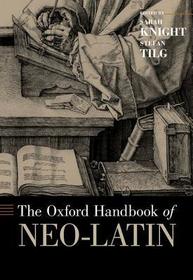
The Oxford Handbook of Neo-Latin
Series: Oxford Handbooks;
- Publisher's listprice GBP 150.00
-
67 725 Ft (64 500 Ft + 5% VAT)
The price is estimated because at the time of ordering we do not know what conversion rates will apply to HUF / product currency when the book arrives. In case HUF is weaker, the price increases slightly, in case HUF is stronger, the price goes lower slightly.
- Discount 10% (cc. 6 773 Ft off)
- Discounted price 60 953 Ft (58 050 Ft + 5% VAT)
Subcribe now and take benefit of a favourable price.
Subscribe
67 725 Ft

Availability
printed on demand
Why don't you give exact delivery time?
Delivery time is estimated on our previous experiences. We give estimations only, because we order from outside Hungary, and the delivery time mainly depends on how quickly the publisher supplies the book. Faster or slower deliveries both happen, but we do our best to supply as quickly as possible.
Product details:
- Publisher OUP USA
- Date of Publication 25 June 2015
- ISBN 9780199948178
- Binding Hardback
- No. of pages632 pages
- Size 183x251x43 mm
- Weight 1225 g
- Language English 0
Categories
Short description:
This Handbook gives an accessible survey of the main genres, contexts, and regions of modern Latin.
MoreLong description:
From the dawn of the early modern period around 1400 until the eighteenth century, Latin was still the European language and its influence extended as far as Asia and the Americas. At the same time, the production of Latin writing exploded thanks to book printing and new literary and cultural dynamics. Latin also entered into a complex interplay with the rising vernacular languages. This Handbook gives an accessible survey of the main genres, contexts, and regions of Neo-Latin, as we have come to call Latin writing composed in the wake of Petrarch (1304-74). Its emphasis is on the period of Neo-Latin's greatest cultural relevance, from the fifteenth to the eighteenth centuries. Its chapters, written by specialists in the field, present individual methodologies and focuses while retaining an introductory character. The Handbook will be valuable to all readers wanting to orientate themselves in the immense ocean of Neo-Latin literature and culture. It will be particularly helpful for those working on early modern languages and literatures as well as to classicists working on the culture of ancient Rome, its early modern reception and the shifting characteristics of post-classical Latin language and literature. Political, social, cultural and intellectual historians will find much relevant material in the Handbook, and it will provide a rich range of material to scholars researching the history of their respective geographical areas of interest.
MoreTable of Contents:
Notes on Contributors
Abbreviations
Introduction, Sarah Knight and Stefan Tilg
Part I. Language and Genre
1 Classical Latin-Mediaeval Latin-Neo-Latin, Keith Sidwell
2 Neo-Latin's Interplay with Other Languages, Demmy Verbeke
3 Lyric Poetry, Victoria Moul
4 Narrative Poetry, Florian Schaffenrath
5 Epigram and Occasional Poetry, David Money
6 Comedy, Stefan Tilg
7 Tragedy, Gary Grund
8 Oratory, Marc Van Der Poel
9 Political Advice, Erik de Bom
10 Historiography, Patrick Baker
11 Letters, Jan Papy
12 Fiction, Mark T. Riley
13 Satire, Ingrid De Smet
Part II. Cultural Contexts
14 School, Robert Black
15 University, Sarah Knight
16 Philosophy, Guido Giglioni
17 Science and Medicine, Brian Ogilvie
18 Contacts with the Arab World, Dag Nikolaus Hasse
19 Biblical Humanism, Andrew Taylor
20 Catholicism, Jason Harris
21 Protestantism, Irena Backus
22 Political Action, Marc Laureys
23 Gender, Diana Robin
24 Social Status, Françoise Waquet
Part III. Countries and Regions
25 Italy, David Marsh
26 France, Paul White
27 British Isles, Estelle Haan
28 German-Speaking Countries, Robert Seidel
29 Iberian Peninsula, Alejandro Coroleu and Catarina Fouto
30 Low Countries, Dirk Sacré
31 Scandinavia, Peter Zeeberg and Annika Ström
32 East-Central Europe, Cristina Neagu
33 Colonial Spanish America and Brazil, Andrew Laird
34 North America, Jean-François Cottier, Haijo Westra, and John Gallucci
35 Asia, Noël Golvers
General References, Sarah Knight and Stefan Tilg

