

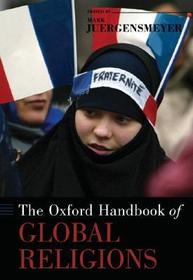
The Oxford Handbook of Global Religions
Series: Oxford Handbooks;
- Publisher's listprice GBP 190.00
-
85 785 Ft (81 700 Ft + 5% VAT)
The price is estimated because at the time of ordering we do not know what conversion rates will apply to HUF / product currency when the book arrives. In case HUF is weaker, the price increases slightly, in case HUF is stronger, the price goes lower slightly.
- Discount 10% (cc. 8 579 Ft off)
- Discounted price 77 207 Ft (73 530 Ft + 5% VAT)
Subcribe now and take benefit of a favourable price.
Subscribe
85 785 Ft

Availability
printed on demand
Why don't you give exact delivery time?
Delivery time is estimated on our previous experiences. We give estimations only, because we order from outside Hungary, and the delivery time mainly depends on how quickly the publisher supplies the book. Faster or slower deliveries both happen, but we do our best to supply as quickly as possible.
Product details:
- Publisher OUP USA
- Date of Publication 26 October 2006
- ISBN 9780195137989
- Binding Hardback
- No. of pages686 pages
- Size 175x249x53 mm
- Weight 1310 g
- Language English 0
Categories
Short description:
This is a reference for understanding world religious societies in their contemporary global diversity. Comprising 60 essays, the volume focuses on communities rather than beliefs, symbols, or rites. It is organised into six sections corresponding to the major living religious traditions: the Indic cultural region, the Buddhist/Confucian, the Jewish, Christian, and Muslim regions, and the African cultural region. In each section an introductory essay discusses the social development of that religious tradition historically. The other essays cover the basic social facts - the community's size, location, organizational and pilgrimage centres, authority figures, patterns of governance, major subgroups and schisms - as well as issues regarding boundary maintenance, political involvement, role in providing cultural identity, and encounters with modernity.
MoreLong description:
This is a reference for understanding world religious societies in their contemporary global diversity. Comprising 60 essays, the volume focuses on communities rather than beliefs, symbols, or rites. It is organized into six sections corresponding to the major living religious traditions: the Indic cultural region, the Buddhist/Confucian, the Jewish, Christian, and Muslim regions, and the African cultural region. In each section an introductory essay discusses the social development of that religious tradition historically. The other essays cover the basic social factsthe communitys size, location, organizational and pilgrimage centers, authority figures, patterns of governance, major subgroups and schismsas well as issues regarding boundary maintenance, political involvement, role in providing cultural identity, and encounters with modernity. Communities in the diaspora and at the periphery are covered, as well as the central geographic regions of the religious traditions. Thus, for example, Islamic communities in Asia and the United States are included along with Islamic societies in the Middle East. The contributors are leading scholars of world religions, many of whom are also members of the communities they study. The essays are written to be informative and accessible to the educated public, and to be respectful of the viewpoints of the communities analyzed.
the 63 contributors are all experts in their fields...[who] impress the reader with the sense of just how malleable religious life has been.

