

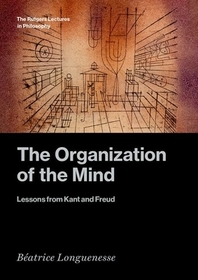
The Organization of the Mind
Lessons from Kant and Freud
Series: The Rutgers Lectures in Philosophy;
- Publisher's listprice GBP 19.99
-
9 025 Ft (8 595 Ft + 5% VAT)
The price is estimated because at the time of ordering we do not know what conversion rates will apply to HUF / product currency when the book arrives. In case HUF is weaker, the price increases slightly, in case HUF is stronger, the price goes lower slightly.
- Discount 10% (cc. 903 Ft off)
- Discounted price 8 122 Ft (7 736 Ft + 5% VAT)
Subcribe now and take benefit of a favourable price.
Subscribe
9 025 Ft

Availability
Estimated delivery time: In stock at the publisher, but not at Prospero's office. Delivery time approx. 3-5 weeks.
Not in stock at Prospero.
Why don't you give exact delivery time?
Delivery time is estimated on our previous experiences. We give estimations only, because we order from outside Hungary, and the delivery time mainly depends on how quickly the publisher supplies the book. Faster or slower deliveries both happen, but we do our best to supply as quickly as possible.
Product details:
- Publisher OUP USA
- Date of Publication 17 March 2026
- ISBN 9780197781265
- Binding Hardback
- No. of pages184 pages
- Size 213x149x20 mm
- Weight 313 g
- Language English 688
Categories
Short description:
The Organization of the Mind is an inquiry into the rational and irrational aspects of our minds, drawing on the thought of the 18th century philosopher, Immanuel Kant, and the 20th century founder of psychoanalysis, Sigmund Freud. The two thinkers are often taken to be fundamentally opposed. Kant, it is said, was a defender of reason, whereas Freud was a radical skeptic about the powers of rationality. In contrast, the book argues that drawing on both their legacies leads to a better understanding of the crises of our times and opens a new path to individual and collective wisdom.
MoreLong description:
As a prominent figure of the 18th century Enlightenment, Kant advocated faith in reason and in the possibility of human progress through the development of human beings' rational capacities. In contrast, as the founder of 20th century psychoanalysis, Freud revealed that rationality itself is rooted in the non-rational soil of mental life. For Freud, rational thinking is pervaded with irrational motivations for thinking and acting. For Kant, the capacity to affirm and endorse on rational grounds one's beliefs and actions is the highest capacity in human beings, one that raises them above all other living beings.
Those contrasts between the two thinkers have led to countless philosophical manifestos pitting Freud and Kant against each other. Some accuse Kant of having played a central role in the promotion of the hubris of modern rationality, which resulted in the domination and destruction of nature. Others accuse Freud of being a prime culprit in the attacks against reason, progress and the very possibility of a better future for humanity.
In The Organization of the Mind, B--atrice Longuenesse paints a more nuanced picture. She arguesthat Kant's analysis of our mental capacities reveals deep-seated and irresolvable conflicts within the mind--an insight that brings him closer to Freud than is often recognized. At the same time, Freud's concept of ---the unconscious--- is as original and revolutionary as Freud claimed. Freud developed that concept in connection to aspects of the mind that earlier philosophers had touched upon but never fully explored: the organization of memory traces and the way they are shaped by emotions and affects. The dynamic interplay of memory, emotion, and affect significantly influences rational thinking itself. Freud's articulation of these connections gives his theory of the unconscious its distinctive power. The Organization of the Mind, based on the author's Rutgers Lectures in Philosophy and the Isaiah Berlin Lectures she gave a year later at Oxford University, creates space for a dialogue between Kant's and Freud's first-personperspectives onthe mind, on the one hand;and, on the other, the third-person approaches of affective and cognitive neuroscience, particularly in the study of memory. These convergences offer fresh directions for contemporary philosophy of mind and psychology.
Table of Contents:
Conflicting Logics of the Mind
Kant on Consciousness and Its Limits
Consciousness, Memory, and Freud's Concept of the Unconscious
Kant and Freud on Morality

