

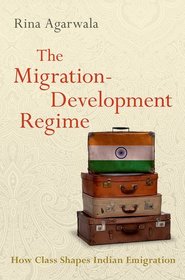
The Migration-Development Regime
How Class Shapes Indian Emigration
Series: MODERN SOUTH ASIA SERIES;
- Publisher's listprice GBP 25.99
-
11 734 Ft (11 175 Ft + 5% VAT)
The price is estimated because at the time of ordering we do not know what conversion rates will apply to HUF / product currency when the book arrives. In case HUF is weaker, the price increases slightly, in case HUF is stronger, the price goes lower slightly.
- Discount 20% (cc. 2 347 Ft off)
- Discounted price 9 387 Ft (8 940 Ft + 5% VAT)
- Discount is valid until: 30 June 2026
Subcribe now and take benefit of a favourable price.
Subscribe
11 734 Ft

Availability
Estimated delivery time: In stock at the publisher, but not at Prospero's office. Delivery time approx. 3-5 weeks.
Not in stock at Prospero.
Why don't you give exact delivery time?
Delivery time is estimated on our previous experiences. We give estimations only, because we order from outside Hungary, and the delivery time mainly depends on how quickly the publisher supplies the book. Faster or slower deliveries both happen, but we do our best to supply as quickly as possible.
Product details:
- Publisher OUP USA
- Date of Publication 16 December 2022
- ISBN 9780197586402
- Binding Paperback
- No. of pages288 pages
- Size 157x232x20 mm
- Weight 381 g
- Language English 263
Categories
Short description:
In The Migration-Development Regime, Rina Agarwala seeks to understand how international migration is affecting sending countries and migrants themselves. Specifically, she examines the case of India, the world's largest emigrant exporter and the world's largest remittance receiver. Rather than seeing emigration as simply a neoliberal disaster or a panacea for globalization, this book shows how the Indian state has long used and controlled its poor and elite emigrants differently to further Indian development, and how Indian emigrants have differentially reacted to state practices over time. These findings help Agarwala expose what is truly novel about India's contemporary emigration practices, which have deepened class inequalities within India more than ever before.
MoreLong description:
A sweeping history of how India has used its poor and elite emigrants to further Indian development and how Indian emigrants have reacted, resisted, and re-shaped India's development in response.
How can states and migrants themselves explain the causes and effects of global migration? The Migration-Development Regime introduces a novel analytical framework to help answer this question in India, the world's largest emigrant exporter and the world's largest remittance-receiving country. Drawing on an archival analysis of Indian government documents, an original data base of Indian migrants' transnational organizations, and over 200 interviews with poor and elite Indian emigrants, recruiters, and government officials, this book exposes the vital role the Indian state (from the colonial era to the present day) has long played in forging and legitimizing class inequalities within India through the management of international emigration. It also exposes how poor and elite emigrants have differentially resisted and re-shaped state emigration practices over time. By taking a long and class-based view, this book recasts contemporary migration not simply as a problematic function of neoliberalism or as a development panacea for sending countries, but as a dynamic historical process that sending states and migrants have long used to shape local development. In doing so, it re-defines the primary problems of global migration, exposes the material and ideological impact that migration has on sending state development, and isolates what is truly novel about contemporary migration.
This beautifully written, lucidly argued book is distinguished by two unusual analytic moves. Agarwala is among the few scholars to explore the historical dynamics of migration from the perspective of a sending state rather than that of destination countries. In addition, she relentlessly excavates class differences, comparing the trajectories of elite and poor Indian emigrants and the contrasting policies shaping their divergent experiences. A provocative and essential contribution.
Table of Contents:
Chapter 1: Introduction
Chapter 2: Migration-Development Regimes (MDRs)
Chapter 3: The Rise and Fall of the Coolie MDR (1834-1947): Racialized Class Exploitation
Chapter 4: The Rise and Fall of the Nationalist MDR (1947-1977): Erasing the Indian Emigrant
Chapter 5: The CEO MDR (1977-present): Liberalizing Emigration and Tapping Emigrants' Financial Contributions
Chapter 6: The CEO MDR: Tapping Elite Emigrants' Ideological Contributions and Forging an Elite Class Pact of "Global Indians"
Chapter 7: Experiencing the CEO MDR From Below: Poor Emigrants
Chapter 8: Experiencing the CEO MDR from Below: Elite Emigrants
Chapter 9: Vulnerabilities in the CEO MDR and a Future Trajectory
References
Index

