

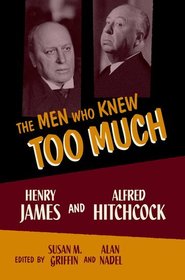
The Men Who Knew Too Much
Henry James and Alfred Hitchcock
- Publisher's listprice GBP 112.50
-
50 793 Ft (48 375 Ft + 5% VAT)
The price is estimated because at the time of ordering we do not know what conversion rates will apply to HUF / product currency when the book arrives. In case HUF is weaker, the price increases slightly, in case HUF is stronger, the price goes lower slightly.
- Discount 10% (cc. 5 079 Ft off)
- Discounted price 45 714 Ft (43 538 Ft + 5% VAT)
Subcribe now and take benefit of a favourable price.
Subscribe
50 793 Ft

Availability
printed on demand
Why don't you give exact delivery time?
Delivery time is estimated on our previous experiences. We give estimations only, because we order from outside Hungary, and the delivery time mainly depends on how quickly the publisher supplies the book. Faster or slower deliveries both happen, but we do our best to supply as quickly as possible.
Product details:
- Publisher OUP USA
- Date of Publication 1 March 2012
- ISBN 9780199764426
- Binding Hardback
- No. of pages288 pages
- Size 160x239x17 mm
- Weight 536 g
- Language English
- Illustrations 40 illustrations 0
Categories
Short description:
The Men Who Knew Too Much innovatively pairs these two greats, showing them to be at once classic and contemporary. Over a dozen major scholars and critics take up works by James and Hitchcock, in paired sets, to explore the often surprising ways that reading James helps us watch Hitchcock and what watching Hitchcock tells us about reading James.
MoreLong description:
Henry James and Alfred Hitchcock knew too much. Self-imposed exiles fully in the know, they approached American and European society as inside-outsiders, a position that afforded them a kind of double vision. Masters of their arts, manipulators of their audiences, prescient and pathbreaking in their techniques, these demanding and meticulous artists fiercely defended authorial and directorial control. Their fictions and films are obsessed with knowledge and its powers: who knows what? What is there to know?
The Men Who Knew Too Much innovatively pairs these two greats, showing them to be at once classic and contemporary. Over a dozen major scholars and critics take up works by James and Hitchcock, in paired sets, to explore the often surprising ways that reading James helps us watch Hitchcock and what watching Hitchcock tells us about reading James. A wide-range of approaches offer fresh insights about spectatorship, narrative structure, and cinematic representation, as well as the relationship between technology and art, the powers of silence, sensory-and sensational-experiences, the impact of cognition, and the uncertainty of interpretation. The essays explore the avowal and disavowal of familial bonds, as well as questions of Victorian convention, female agency, and male anxiety. And they fruitfully engage issues related to patriarchy, colonialism, national, transnational, and global identities. The capacious collection, with its brilliant insights and intellectual surprises, is equally compelling in its range and cogency for James readers and film theorists, for Hitchcock fans and James scholars.
The Men Who Knew Too Much offers a series of inspiring discussions about the process of adaptation as experienced by Hitchcock, James, and their respective protagonists. Combining close textual analysis with suggestive theoretical insights, the book shows how individuals in different socio-historical contexts negotiate important issue of gender, social identity, knowledge and authority. By reflecting on their struggles, we might learn something about ourselves and our future courses of action.
Table of Contents:
Reading James with Hitchcock, Reading Hitchcock with James
National Bodies
Secrets, Lies, and "Virtuous Attachments": The Ambassadors and The 39 Steps
Henry James and Alfred Hitchcock after the American Century: Circulation and Non-Return in The American Scene and Strangers on a Train
Colonial Discourse and the Unheard Other in Washington Square and The Man Who Knew Too Much
Bump: Concussive Knowledge in James and Hitchcock
James's Birdcage/Hitchcock's Birds
Sounds of Silence in The Wings of the Dove and Blackmail
The Perfect Enigma
Hands, Objects and Love in James and Hitchcock: Reading the Touch in The Golden Bowl and Notorious
The Touch of the Real: Circumscribing Vertigo
Specters of Respectability: Victorian Horrors in The Turn of the Screw and Psycho
Caged Heat: Feminist Rebellion in Henry James's In the Cage and Alfred Hitchcock's Rear Window
Shadows of Modernity: What Maisie Knew and Shadow of a Doubt
Awkward Ages: James and Hitchcock In Between
Works Cited
Contributors
Index

