

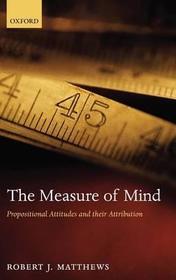
The Measure of Mind
Propositional Attitudes and their Attribution
- Publisher's listprice GBP 72.00
-
32 508 Ft (30 960 Ft + 5% VAT)
The price is estimated because at the time of ordering we do not know what conversion rates will apply to HUF / product currency when the book arrives. In case HUF is weaker, the price increases slightly, in case HUF is stronger, the price goes lower slightly.
- Discount 10% (cc. 3 251 Ft off)
- Discounted price 29 257 Ft (27 864 Ft + 5% VAT)
Subcribe now and take benefit of a favourable price.
Subscribe
32 508 Ft

Availability
printed on demand
Why don't you give exact delivery time?
Delivery time is estimated on our previous experiences. We give estimations only, because we order from outside Hungary, and the delivery time mainly depends on how quickly the publisher supplies the book. Faster or slower deliveries both happen, but we do our best to supply as quickly as possible.
Product details:
- Publisher OUP Oxford
- Date of Publication 28 June 2007
- ISBN 9780199211258
- Binding Hardback
- No. of pages278 pages
- Size 240x161x18 mm
- Weight 589 g
- Language English 0
Categories
Short description:
In his The Measure of Mind, Robert J. Matthews provides a sustained critique of a widely held representationalist account of beliefs, desires, and other propositional attitudes. He goes on to develop an alternative, more plausible measurement-theoretic account of propositional attitudes and the sentences by which we attribute them. This original work will be of considerable interest to scholars and graduate students working in the philosophy of mind and language.
MoreLong description:
The Measure of Mind provides a sustained critique of a widely held representationalist view of propositional attitudes and their role in the production of thought and behaviour. On this view, having a propositional attitude is a matter of having an explicit representation that plays a particular causal/computational role in the production of thought and behaviour. Robert J. Matthews argues that this view does not enjoy the theoretical or the empirical support that proponents claim for it; moreover, the view misconstrues the role of propositional attitude attributions in cognitive scientific theorizing.
The Measure of Mind goes on to develop an alternative measurement-theoretic account of propositional attitudes and the sentences by which we attribute them. On this account, the sentences by which we attribute propositional attitudes function semantically like the sentences by which we attribute a quantity of some physical magnitude (e.g., having a mass of 80 kilos). That is, in much the same way that we specify a quantity of some physical magnitude by means of its numerical representative on a measurement scale, we specify propositional attitude of a given type by means of its representative in a linguistically-defined measurement space. Propositional attitudes turn out to be causally efficacious aptitudes for thought and behaviour, not semantically evaluable mental particulars of some sort. Matthews' measurement-theoretic account provides a more plausible view of the explanatorily relevant properties of propositional attitudes, the semantics of propositional attitude attributions, and the role of such attributions in computational cognitive scientific theorizing.
fascinating book...Robert Matthews pursues, with great rigour and tenacity, the question of how we should understand our practice of attributing propositional attitudes and, in particular, the specific questions of how subjects must be built (given the best available accounts of the building materials) if they are to serve as proper targets for that practice...I cannot do justice here to the detail and care involved in Matthew's presentation of his case.
Table of Contents:
Preface/Acknowledgments
A Prospective Introduction
Part I: The Received View and Its Troubles
The Received View
Troubles with the Received View
Are Propositional Attitudes Relations?
Part Two: A Measurement-Theoretic Account of Propositional Attitudes and Their Attribution
Foundations of a Measurement-Theoretic Account of Propositional Attitudes
The Basic Measurement-Theoretic Account
Elaboration and Explication of the Proposed Measurement-Theoretic Account
References
Index

