

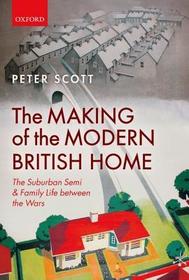
The Making of the Modern British Home
The Suburban Semi and Family Life between the Wars
- Publisher's listprice GBP 142.50
-
64 338 Ft (61 275 Ft + 5% VAT)
The price is estimated because at the time of ordering we do not know what conversion rates will apply to HUF / product currency when the book arrives. In case HUF is weaker, the price increases slightly, in case HUF is stronger, the price goes lower slightly.
- Discount 10% (cc. 6 434 Ft off)
- Discounted price 57 905 Ft (55 148 Ft + 5% VAT)
Subcribe now and take benefit of a favourable price.
Subscribe
64 338 Ft

Availability
printed on demand
Why don't you give exact delivery time?
Delivery time is estimated on our previous experiences. We give estimations only, because we order from outside Hungary, and the delivery time mainly depends on how quickly the publisher supplies the book. Faster or slower deliveries both happen, but we do our best to supply as quickly as possible.
Product details:
- Publisher OUP Oxford
- Date of Publication 29 August 2013
- ISBN 9780199677207
- Binding Hardback
- No. of pages290 pages
- Size 240x163x24 mm
- Weight 612 g
- Language English
- Illustrations 39 black and white figures/illustrations 0
Categories
Short description:
Explores the impact of the modern suburban semi-detached house on British family life during the 1920s and 1930s
MoreLong description:
The Making of the Modern British Home explores the impact of the modern suburban semi-detached house on British family life during the 1920s and 1930s - focusing primarily on working-class households who moved from cramped inner-urban accommodation to new suburban council or owner-occupied housing estates. Migration to suburbia is shown to have initiated a dramatic transformation in lifestyles - from a `traditional' working-class mode of living, based around long-established tightly-knit urban communities, to a recognisably `modern' mode, centred around the home, the nuclear family, and building a better future for the next generation. This process had far-reaching impacts on family life, entailing a change in household priorities to meet the higher costs of suburban living, which in turn impacted on many aspects of household behaviour, including family size.
This volume also constitutes a general history of the development of both owner-occupied and municipal suburban housing estates in interwar Britain, including the evolution of housing policy; the housing development process; housing and estate design, lay-outs, and architectural features; marketing owner-occupation and consumer durables to a mass market; furnishing the new suburban home; making ends meet; suburban gardens; social filtering and conflict on the new estates; and problems of 'mis-selling' and 'Jerry building'. Peter Scott integrates the social history of the interwar suburbs with their economic, business, marketing, and architectural/planning histories, demonstrating how these elements interacted to produce a new model of working-class lifestyles and 'respectability' which marked a fundamental break with pre-1914 working-class urban communities.
Scott's well-grounded and comprehensive account will be the definitive book on this subject for years to come.
Table of Contents:
Dedication
Preface
Acknowledgements
List of abbreviations and a note on currency
The new suburban world
The road to 'homes fit for heroes'
Municipal suburbia
Developing owner-occupied suburbia
Marketing owner-occupation to the masses
Life in owner-occupied suburbia
Equipping the suburban home
The suburban garden
Visible and invisible walls: social differentiation and conflict in interwar suburbia
A crisis averted by war? Mis-selling, consumer protest, and the Borders case
The legacy of the interwar semi
Appendix: A note on sources
Bibliography
Index

