

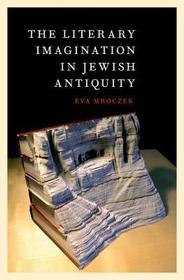
The Literary Imagination in Jewish Antiquity
- Publisher's listprice GBP 152.50
-
68 853 Ft (65 575 Ft + 5% VAT)
The price is estimated because at the time of ordering we do not know what conversion rates will apply to HUF / product currency when the book arrives. In case HUF is weaker, the price increases slightly, in case HUF is stronger, the price goes lower slightly.
- Discount 10% (cc. 6 885 Ft off)
- Discounted price 61 968 Ft (59 018 Ft + 5% VAT)
Subcribe now and take benefit of a favourable price.
Subscribe
68 853 Ft

Availability
printed on demand
Why don't you give exact delivery time?
Delivery time is estimated on our previous experiences. We give estimations only, because we order from outside Hungary, and the delivery time mainly depends on how quickly the publisher supplies the book. Faster or slower deliveries both happen, but we do our best to supply as quickly as possible.
Product details:
- Publisher OUP USA
- Date of Publication 16 June 2016
- ISBN 9780190279837
- Binding Hardback
- No. of pages282 pages
- Size 239x155x30 mm
- Weight 440 g
- Language English
- Illustrations 4 illus. 0
Categories
Short description:
How did Jews understand sacred writing before the concepts of "Bible" and "book" emerged? The Literary Imagination in Jewish Antiquity challenges anachronistic categories to reveal new aspects of how ancient Jews imagined written revelation.
MoreLong description:
The discovery of the Dead Sea Scrolls revealed a world of early Jewish writing larger than the Bible, from multiple versions of biblical texts to "revealed" books not found in our canon. Despite this diversity, the way we read Second Temple Jewish literature remains constrained by two anachronistic categories: a theological one, "Bible," and a bibliographic one, "book." The Literary Imagination in Jewish Antiquity suggests ways of thinking about how Jews understood their own literature before these categories had emerged.
Using familiar sources such as the Psalms, Ben Sira, and Jubilees, Mroczek tells an unfamiliar story about sacred writing not bound in a Bible. In many texts, we see an awareness of a vast tradition of divine writing found in multiple locations only partially revealed in available scribal collections. Ancient heroes like David are not simply imagined as scriptural authors, but multi-dimensional characters who come to be known as great writers and honored as founders of growing textual traditions. Scribes recognize the divine origin of texts like the Enoch literature and other writings revealed to ancient patriarchs, which present themselves not as derivative of material we now call biblical, but prior to it. Sacred writing stretches back to the dawn of time, yet new discoveries are always around the corner.
While listening to the way ancient writers describe their own literature-their own metaphors and narratives about writing-this book also argues for greater suppleness in our own scholarly imagination, no longer bound by modern canonical and bibliographic assumptions.
Mroczek's argument is innovative, cogent, and commendable as a corrective to situate scholars' historical perspective.
Table of Contents:
Acknowledgements
Introduction: Beyond Bible and Book
1. The Mirage of the Bible: The Case of the Book of Psalms
Introduction: Milton's Vial and the Uncontained Text
I. Biblical Spectacles
II. Why there was no "Book of Psalms" in the Second Temple Period: Manuscripts and the Imagination
III. Psalms without Psalters: Rethinking Psalms Traditions Beyond "Bible" and "Book"
Conclusion: Bibliographic Surprises in Early Judaism
2. The Sweetest Voice: the Poetics of Attribution
Introduction: What Did Ancient Attribution Claim? Aesthetics and Authorship
I. Characters in Search of Stories: Authority, Pseudonymity, and Poetics
II. The Psalm Superscriptions and Davidic Voice
III. Sinful King to Angelic Bard: The Making of the Sweet Singer of Israel
Conclusion: The Life of the Writer
3. Like A Canal from a River: Scribal Products and Projects
Introduction: The Poetic "I": Historical or Legendary?
I. The First Jewish Author? Ben Sira and the Authorial Name
II. What is "The Book of Ben Sira"? Open Books and Authentic Text
III. The Afterlives of Ben Sira as Text and Character
Conclusion: Metaphors and Manuscripts
4. Shapes of Scriptures: The Non-Biblical Library of Early Judaism
Introduction: "Collecting, if possible, all the books in the world"
I. Mental Architecture and the Shape of the Sacred Library in Early Judaism
II. From Forgery to Exegesis: The Non-Biblical Libraries of Modern Publishing
III. Jubilees as Bibliography: A Native History of Written Revelation
Conclusion: Bibliography and Totality
5. Outside the Number: Counting, Canons, and the Boundaries of Revelation
Introduction: When Haile Selassie Finished the Bible
I. Qualitative Numbers: Twenty-Two and Twenty-Four Books in Josephus and 4Ezra
II. Beyond Psalm 150: When King David Finished the Psalter
III. Canons, Closure, and the Insufficiency of Scripture
Conclusion: Revelation Out of Reach
Conclusion
Bibliography
Index

