

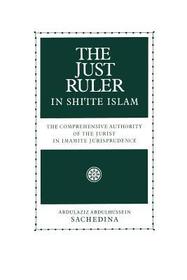
The Just Ruler in Shi'ite Islam
The Comprehensive Authority of the Jurist in Imamite Jurisprudence
- Publisher's listprice GBP 72.00
-
34 398 Ft (32 760 Ft + 5% VAT)
The price is estimated because at the time of ordering we do not know what conversion rates will apply to HUF / product currency when the book arrives. In case HUF is weaker, the price increases slightly, in case HUF is stronger, the price goes lower slightly.
- Discount 10% (cc. 3 440 Ft off)
- Discounted price 30 958 Ft (29 484 Ft + 5% VAT)
Subcribe now and take benefit of a favourable price.
Subscribe
34 398 Ft

Availability
printed on demand
Why don't you give exact delivery time?
Delivery time is estimated on our previous experiences. We give estimations only, because we order from outside Hungary, and the delivery time mainly depends on how quickly the publisher supplies the book. Faster or slower deliveries both happen, but we do our best to supply as quickly as possible.
Product details:
- Publisher OUP USA
- Date of Publication 19 November 1998
- ISBN 9780195119152
- Binding Paperback
- No. of pages296 pages
- Size 230x155x19 mm
- Weight 481 g
- Language English 0
Categories
Short description:
Following the Islamic revolution of 1978-79 in Iran, the new Islamic regime justified the rule of the Ayatollah Khomeni, and of the Shi'ite imams in general, on the basis of the doctrine that righteous jurist is best suited to establish the ideal public order. Sachedina shows that this concept has no apparent parallel in Sunni Islam. In this study, he seeks the origins of this concept in the Sunni/Shi'ite schism that took place after the death of the Prophet, and then traces its historical evolution up to the present time.
MoreLong description:
Following the Islamic revolution of 1978-79 in Iran, the new Islamic regime justified the rule of the Ayatollah Khomeni, and of the Shi'ite imams in general, on the basis of the doctrine that righteous jurist is best suited to establish the ideal public order. Sachedina shows that this concept has no apparent parallel in Sunni Islam. In this study, he seeks the origins of this concept in the Sunni/Shi'ite schism that took place after the death of the Prophet, and then traces its historical evolution up to the present time.
Makes a welcome addition to the growing literature on Shi'ite political thought. The author draws on an impressive body of legal works, both classical and more recent...in order to demonstrate the orthodox view of authority and its implications in the case of the Imam, the temporal ruler, and the jurist.

