

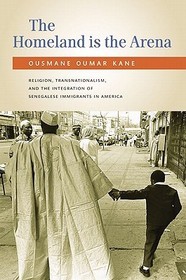
The Homeland Is the Arena
Religion and Senegalese Immigrants in America
- Publisher's listprice GBP 72.00
-
32 508 Ft (30 960 Ft + 5% VAT)
The price is estimated because at the time of ordering we do not know what conversion rates will apply to HUF / product currency when the book arrives. In case HUF is weaker, the price increases slightly, in case HUF is stronger, the price goes lower slightly.
- Discount 10% (cc. 3 251 Ft off)
- Discounted price 29 257 Ft (27 864 Ft + 5% VAT)
Subcribe now and take benefit of a favourable price.
Subscribe
32 508 Ft

Availability
printed on demand
Why don't you give exact delivery time?
Delivery time is estimated on our previous experiences. We give estimations only, because we order from outside Hungary, and the delivery time mainly depends on how quickly the publisher supplies the book. Faster or slower deliveries both happen, but we do our best to supply as quickly as possible.
Product details:
- Publisher OUP USA
- Date of Publication 26 May 2011
- ISBN 9780199732302
- Binding Hardback
- No. of pages336 pages
- Size 160x239x27 mm
- Weight 544 g
- Language English 0
Categories
Short description:
Addresses an historically neglected aspect of international migration, analyzing the role played by transnational religion in the adaptation of Senegalese immigrants in America in the late twentieth century.
MoreLong description:
As Senegal prepares to celebrate fifty years of independence from French colonial rule, academic and policy circles are engaged in a vigorous debate about its experience in nation building. An important aspect of this debate is the impact of globalization on Senegal, particularly the massive labor migration that began directly after independence. From Tokyo to Melbourne, from Turin to Buenos Aires, from to Paris to New York, 300,000 Senegalese immigrants are simultaneously negotiating their integration into their host society and seriously impacting the development of their homeland.
This book addresses the modes of organization of transnational societies in the globalized context, and specifically the role of religion in the experience of migrant communities in Western societies. Abundant literature is available on immigrants from Latin America and Asia, but very little on Africans, especially those from French speaking countries in the United States. Ousmane Kane offers a case study of the growing Senegalese community in New York City. By pulling together numerous aspects (religious, ethnic, occupational, gender, generational, socio-economic, and political) of the experience of the Senegalese migrant community into an integrated analysis, linking discussion of both the homeland and host community, this book breaks new ground in the debate about postcolonial Senegal, Muslim globalization and diaspora studies in the United States. A leading scholar of African Islam, Ousmane Kane has also conducted extensive research in North America, Europe and Africa, which allows him to provide an insightful historical ethnography of the Senegalese transnational experience.
This book is enjoyable...a much-needed
Table of Contents:
Foreword
Orthography
Abbreviations
Glossary
PROLOGUE
Part I
Religion, State, and Society in Modern Senegal
Sufis, Society, and the State
PART II
Integrating American Society
Senegalese Enclaves in New York City
The Formation and Transformation of Sufi Societies
Relations to Other Immigrant Associations
Part III
Building connections with Senegal
The Transnational Spiritual Economy
Gender and Generational Relations
Immigration or Death
Epilogue "Good Muslims" , "Good Blacks"
References

