

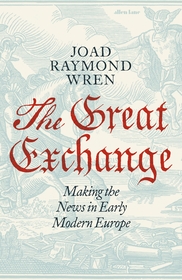
The Great Exchange: Making the News in Early Modern Europe
-
GET 20% OFF
- Publisher's listprice GBP 40.00
-
18 060 Ft (17 200 Ft + 5% VAT)
The price is estimated because at the time of ordering we do not know what conversion rates will apply to HUF / product currency when the book arrives. In case HUF is weaker, the price increases slightly, in case HUF is stronger, the price goes lower slightly.
- Discount 20% (cc. 3 612 Ft off)
- Discounted price 14 448 Ft (13 760 Ft + 5% VAT)
- Discount is valid until: 31 August 2026
14 448 Ft

Availability
Estimated delivery time: In stock at the publisher, but not at Prospero's office. Delivery time approx. 3-5 weeks.
Not in stock at Prospero.
Why don't you give exact delivery time?
Delivery time is estimated on our previous experiences. We give estimations only, because we order from outside Hungary, and the delivery time mainly depends on how quickly the publisher supplies the book. Faster or slower deliveries both happen, but we do our best to supply as quickly as possible.
Product details:
- Publisher Penguin Books Ltd
- Date of Publication 10 July 2025
- ISBN 9780241188538
- Binding Hardback
- No. of pages624 pages
- Size 241x164x39 mm
- Weight 1057 g
- Language English 729
Categories
Long description:
‘Highly ambitious and impressive ... a rich, multifaceted and thought-provoking book'
Noel Malcolm, Times Literary Supplement
News moves. It is a battle, a scandal, a disaster. It is a letter, a newspaper, a proclamation. News is a material thing, but also something between us, something we take into us and feel.
This book tells the story of news from the sunset of the Middle Ages to the rise of mass media in modern times. It begins in Renaissance Italy, with the envoys and merchants who drew in and disseminated news across Europe, establishing its channels and conventions. Following the beat of news around the continent, it uncovers a vast, invisible network traversing the boundaries of geography and politics, religion and language.
Joad Raymond Wren allows the reader to see news – of the battle of Lepanto, the siege of Vienna – spreading around this network in real time. Dispelling the tenacious myth that news was until the printing press scarce and unreliable, and until the telegraph slow and provincial, he opens up windows onto a world buzzing with news from faraway. News brought the distant closer, and provided the means for Europe to know itself. The continent was, for a time, held together by that most essential of human acts: communication.

