

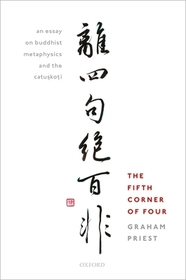
The Fifth Corner of Four
An Essay on Buddhist Metaphysics and the Catuṣkoṭi
- Publisher's listprice GBP 84.00
-
37 926 Ft (36 120 Ft + 5% VAT)
The price is estimated because at the time of ordering we do not know what conversion rates will apply to HUF / product currency when the book arrives. In case HUF is weaker, the price increases slightly, in case HUF is stronger, the price goes lower slightly.
- Discount 10% (cc. 3 793 Ft off)
- Discounted price 34 133 Ft (32 508 Ft + 5% VAT)
Subcribe now and take benefit of a favourable price.
Subscribe
37 926 Ft

Availability
Estimated delivery time: In stock at the publisher, but not at Prospero's office. Delivery time approx. 3-5 weeks.
Not in stock at Prospero.
Why don't you give exact delivery time?
Delivery time is estimated on our previous experiences. We give estimations only, because we order from outside Hungary, and the delivery time mainly depends on how quickly the publisher supplies the book. Faster or slower deliveries both happen, but we do our best to supply as quickly as possible.
Product details:
- Publisher OUP Oxford
- Date of Publication 8 November 2018
- ISBN 9780198758716
- Binding Hardback
- No. of pages208 pages
- Size 241x165x18 mm
- Weight 466 g
- Language English 0
Categories
Short description:
Graham Priest presents an exploration of the development of Buddhist metaphysics, which is viewed through the lens of the Catuṣkoṭi. In its earliest and simplest form this is a logical/metaphysical principle which says that every claim is true, false, both, or neither; but Priest shows how the principle itself evolves as the metaphysics develops.
MoreLong description:
Graham Priest presents an exploration of Buddhist metaphysics, drawing on texts which include those of Nãgãrjuna and Dõgen. The development of Buddhist metaphysics is viewed through the lens of the catuṣkoṭi. At its simplest, and as it appears in the earliest texts, this is a logical/ metaphysical principle which says that every claim is true, false, both, or neither; but the principle itself evolves, assuming new forms, as the metaphysics develops. An important step in the evolution incorporates ineffability. Such things make no sense from the perspective of a logic which endorses the principles of excluded middle and non-contradiction, which are standard fare in Western logic. However, the book shows how one can make sense of them by applying the techniques of contemporary non-classical logic, such as those of First Degree Entailment, and Plurivalent Logic. An important issue that emerges as the book develops is the notion of non-duality and its transcendence. This allows many of the threads of the book to be drawn together at its end. All matters are explained, in as far as possible, in a way that is accessible to those with no knowledge of Buddhist philosophy or contemporary non-classical logic.
This book is simply beautiful. With its elegant cover art and comfortable size, it is a pleasure to look at, to hold, and to read. Moreover, Priest ... does a lovely job of tracing the evolution of Buddhism ... Highly recommended.
Table of Contents:
Before the Beginning
Preface
Part I: Early India
General Background
Quintum Non Datur
Well-Founded Metaphysics
Part II: Later India
Emptiness
The Fifth Corner
Paradox and Ineffability
Part III: East Asia
And So On
The Golden Lion
Enlightenment
After the End
A Methodological Coda

