

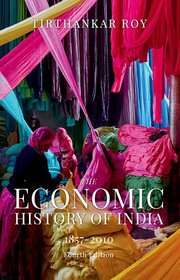
The Economic History of India, 1857-2010
- Publisher's listprice GBP 31.99
-
14 443 Ft (13 755 Ft + 5% VAT)
The price is estimated because at the time of ordering we do not know what conversion rates will apply to HUF / product currency when the book arrives. In case HUF is weaker, the price increases slightly, in case HUF is stronger, the price goes lower slightly.
- Discount 10% (cc. 1 444 Ft off)
- Discounted price 12 998 Ft (12 380 Ft + 5% VAT)
Subcribe now and take benefit of a favourable price.
Subscribe
14 443 Ft

Availability
Only to order.
Why don't you give exact delivery time?
Delivery time is estimated on our previous experiences. We give estimations only, because we order from outside Hungary, and the delivery time mainly depends on how quickly the publisher supplies the book. Faster or slower deliveries both happen, but we do our best to supply as quickly as possible.
Product details:
- Edition number 4
- Publisher OUP India
- Date of Publication 20 October 2020
- Number of Volumes Paperback
- ISBN 9780190128296
- Binding Paperback
- No. of pages400 pages
- Size 216x141x28 mm
- Weight 376 g
- Language English 47
Categories
Short description:
From the end of the eighteenth century, two distinct global processes began to transform livelihoods and living conditions in the South Asia region. These were the rise of British colonial rule and globalization, that is, the integration of the region in the emerging world markets for goods, capital, and labour services. Two hundred years later, India was the home to many of the world's poorest people as well as one of the fastest growing market economies in the world. Does a study of the past help to explain the paradox of growth amidst poverty? The Economic History of India: 1857-2010 claims that the roots of this paradox go back to India's colonial past, when internal factors like geography and external forces like globalization and imperial rule created prosperity in some areas and poverty in others.
MoreLong description:
From the end of the eighteenth century, two distinct global processes began to transform livelihoods and living conditions in the South Asia region. These were the rise of British colonial rule and globalization, that is, the integration of the region in the emerging world markets for goods, capital, and labour services. Two hundred years later, India was the home to many of the world's poorest people as well as one of the fastest growing market economies in the world. Does a study of the past help to explain the paradox of growth amidst poverty? The Economic History of India: 1857-2010 claims that the roots of this paradox go back to India's colonial past, when internal factors like geography and external forces like globalization and imperial rule created prosperity in some areas and poverty in others.
Looking at the recent scholarship in this area, this revised edition covers new subjects like environment and princely states. The author sets out the key questions that a study of long-run economic change in India should begin with and shows how historians have answered these questions and where the gaps remain.
Table of Contents:
List of Tables
List of Figures
List of Maps
List of Abbreviations
1. INTRODUCTION
2. TRANSITION TO COLONIALISM: 1707-1857
3. THE PATTERN OF ECONOMIC GROWTH: 1857-1947
4. AGRICULTURE
5. SMALL-SCALE INDUSTRY
6. LARGE-SCALE INDUSTRY
7. PLANTATIONS, MINES, BANKING
8. INFRASTRUCTURE
9. HOW THE GOVERNMENT WORKED
10. POPULATION
11. THE ECONOMY AND THE ENVIRONMENT
12. THE PRINCELY STATES
13. ECONOMIC CHANGE IN INDIA 1950-2010
14. CONCLUSION
SELECTED SOURCES
GLOSSARY OF INDIAN TERMS
INDEX
About the Author

