

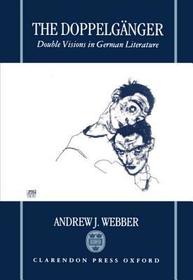
The Doppelgänger
Double Visions in German Literature
- Publisher's listprice GBP 222.50
-
100 458 Ft (95 675 Ft + 5% VAT)
The price is estimated because at the time of ordering we do not know what conversion rates will apply to HUF / product currency when the book arrives. In case HUF is weaker, the price increases slightly, in case HUF is stronger, the price goes lower slightly.
- Discount 10% (cc. 10 046 Ft off)
- Discounted price 90 413 Ft (86 108 Ft + 5% VAT)
Subcribe now and take benefit of a favourable price.
Subscribe
100 458 Ft

Availability
printed on demand
Why don't you give exact delivery time?
Delivery time is estimated on our previous experiences. We give estimations only, because we order from outside Hungary, and the delivery time mainly depends on how quickly the publisher supplies the book. Faster or slower deliveries both happen, but we do our best to supply as quickly as possible.
Product details:
- Publisher Clarendon Press
- Date of Publication 27 June 1996
- ISBN 9780198159049
- Binding Hardback
- No. of pages390 pages
- Size 224x144x27 mm
- Weight 643 g
- Language English
- Illustrations 4 halftones 0
Categories
Short description:
The Doppelgänger, or double, has been a key figure in literary representations of subjectivity since the Romantic movement. This book, based largely on psychoanalytic models, argues that the double embodies an ongoing crisis of identity in and around German culture in the nineteenth century. From the tales of Hoffmann to the Gothic revivals of early German cinema, it is seen to haunt both vision and language, representing a traumatic split between desire and knowledge.
MoreLong description:
Ever since its literary coinage in Jean Paul's novel, Siebenkäs (1796), the concept of Doppelgänger has had significant influence upon representations of the self in German literature. This study charts the development of the double from its origins in the Romantic period, through its more marginal - but nonetheless significant - manifestations in the post-Romantic culture, to its revival at the fin-de-si?cle and transfer to the silent screen.
The book features an introduction to the practice and theory underlying the use of the Doppelgänger, with particular reference to psychoanalysis, followed by chapters on Jean Paul, Hoffmann, Kleist, poetic realism (Droste-Hülshoff, Keller, Storm) and modernism (Kafka, Rilke, Hoffmannsthal, Schnitzler, Meyrink, Werfal). This study shows that the often underestimated figure of the double may provide a key to the epistomological, aesthetic and psychosexual structures of the texts it visits and revisits, with a particular focus on its effects in the fields of vision and language.
It is simply impossible to provide here an adequate description of a study that deals with a fairly large number of text and, more to the point, does so often from wide-ranging theoretical viewpoints eclectically applied.

