

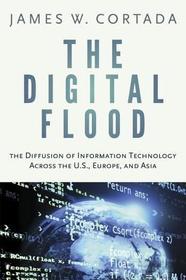
The Digital Flood
The Diffusion of Information Technology Across the U.S., Europe, and Asia
- Publisher's listprice GBP 117.50
-
53 051 Ft (50 525 Ft + 5% VAT)
The price is estimated because at the time of ordering we do not know what conversion rates will apply to HUF / product currency when the book arrives. In case HUF is weaker, the price increases slightly, in case HUF is stronger, the price goes lower slightly.
- Discount 10% (cc. 5 305 Ft off)
- Discounted price 47 746 Ft (45 473 Ft + 5% VAT)
Subcribe now and take benefit of a favourable price.
Subscribe
53 051 Ft

Availability
printed on demand
Why don't you give exact delivery time?
Delivery time is estimated on our previous experiences. We give estimations only, because we order from outside Hungary, and the delivery time mainly depends on how quickly the publisher supplies the book. Faster or slower deliveries both happen, but we do our best to supply as quickly as possible.
Product details:
- Publisher OUP USA
- Date of Publication 27 September 2012
- ISBN 9780199921553
- Binding Hardback
- No. of pages816 pages
- Size 163x234x45 mm
- Weight 1273 g
- Language English
- Illustrations 10 b/w line 0
Categories
Short description:
The history of how computers spread to over 20 nations globally in less than six decades, exploring economic, political, social and technological reasons and consequences. It is based on extensive research into primary and secondary sources, and concludes with a discussion of implications for key players in the globalized economy.
MoreLong description:
No technology seems to have spread so fast around the world in such a short period of time as computers. It was a phenomenon that predated the arrival of the Internet and that began to change how businesses, governments, and whole societies functioned. The diffusion of information technologies occurred in dozens of countries all over the world with fascinating similarities and differences.
In this book, historian James W. Cortada provides the first world-wide history of how computers appeared and were used in North America, all of Europe, and in most of Asia in barely a half century. He explores the causes of diffusion, arguing that more than the technology itself, other conditions were required for the spread of computers, such as standards of living, education, the Cold War, and globalization of the economy. He argues that these technologies are the glue that hold together today's economies and are propelling increases in the quality of life of over a billion people moving into the middle class.
Based on archival and secondary research, extensive use of economic data, and detailed country case studies of over a dozen nations, Cortada tells the history of how computers were discovered, invented, built, and used, and the consequences for whole regions. This is the first attempt by any expert to write a global history of information technologies, and specifically, about how these spread. It is economic and business history, but also a guide to those who want to understand what is happening today in such nations as India, China, and other emerging economies as the Computer Revolution continues. He has insights for historians, economists, public officials, and business executives.
Cortada's book is unique and will clearly serve as the standard reference on the subject for years.
Table of Contents:
Preface
1. How Much Computing Is in The World?
2. Diffusion of Computing Starts in the United States
3. Early Western European Deployment: Great Britain, France and West Germany
4. Diffusion of Computing in Italy, Netherlands, and Sweden
5. How Western Europe Embraced Information Technologies
6. Limits of Diffusion: Computing in the Soviet Union, German Democratic Republic and Eastern Europe
7. Computing Comes to Japan
8. Diffusion of Computing into South Korea, Taiwan, and Singapore
9. China: Embracing IT in Changing Times
10. India AND THE Limits of Digital Diffusion
11. How Asia Embraced Information Technologies
12. Diffusion of Information Technologies: Results and Implications
Appendices:
A. Preparing a Global Diffusion History: Lessons Learned, Paths Not Taken
B. Wave One and Wave Two Compared
Endnotes
Bibliographic Essay
Index

