

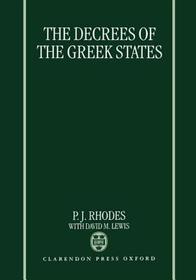
The Decrees of the Greek States
- Publisher's listprice GBP 382.50
-
172 698 Ft (164 475 Ft + 5% VAT)
The price is estimated because at the time of ordering we do not know what conversion rates will apply to HUF / product currency when the book arrives. In case HUF is weaker, the price increases slightly, in case HUF is stronger, the price goes lower slightly.
- Discount 10% (cc. 17 269 Ft off)
- Discounted price 155 429 Ft (148 028 Ft + 5% VAT)
Subcribe now and take benefit of a favourable price.
Subscribe
172 698 Ft

Availability
printed on demand
Why don't you give exact delivery time?
Delivery time is estimated on our previous experiences. We give estimations only, because we order from outside Hungary, and the delivery time mainly depends on how quickly the publisher supplies the book. Faster or slower deliveries both happen, but we do our best to supply as quickly as possible.
Product details:
- Publisher OUP Oxford
- Date of Publication 13 November 1997
- ISBN 9780198149736
- Binding Hardback
- No. of pages654 pages
- Size 243x164x41 mm
- Weight 1260 g
- Language English 80
Categories
Short description:
Professor Rhodes, with Professor Lewis, has collected the evidence for decrees through which the states of the ancient Greek world were governed, and uses the evidence to study the decision-making procedures and the extent to which the citizens were actively involved. The book consists of a catalogue of the evidence for 1200+ city states, introduced by a discussion of the Athenian evidence, and with a conclusion in which the language of the decrees and the working of the political machinery in various cities is analysed.
MoreLong description:
The many states of the ancient greek world were governed by small councils and assemblies of adult male citizens. The decisions of these bodies took the form of decrees. This book collects the evidence for decrees, many of which were inscribed on stone or metal, or appear in literary texts - either directly quoted, or indirectly reported. This evidence is used by Professor Rhodes, with Professor Lewis, to study the decision-making procedures of the Greek states, and the extent to which the citizens were actively involved in those procedures from the sixth century BC to the fourth century AD.
An introductory section on Athens shows what questions can be asked and what answers can be given when there is a good supply of epigraphic material and literary texts. This is followed by the catalogue, systematically chronicling the usage of individual states throughout the Greek world with brief discussions of the interesting features in each case. The final section disusses the language of the decrees and the working of the political machinery that they reveal.
The authors have largely succeeded in the difficult task of efficiently organizing a mountain of information....this is a thoroughly professional study....One of the great strengths of this book is the opportunity for comparison it invites through the collection of evidence from the entire Greek world.

