

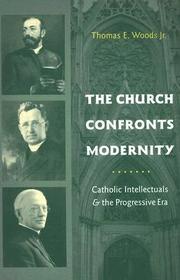
The Church Confronts Modernity
Catholic Intellectuals and the Progressive Era
Series: Religion and American Culture;
- Publisher's listprice GBP 28.00
-
13 377 Ft (12 740 Ft + 5% VAT)
The price is estimated because at the time of ordering we do not know what conversion rates will apply to HUF / product currency when the book arrives. In case HUF is weaker, the price increases slightly, in case HUF is stronger, the price goes lower slightly.
- Discount 10% (cc. 1 338 Ft off)
- Discounted price 12 039 Ft (11 466 Ft + 5% VAT)
Subcribe now and take benefit of a favourable price.
Subscribe
13 377 Ft

Availability
Temporarily out of stock.
Why don't you give exact delivery time?
Delivery time is estimated on our previous experiences. We give estimations only, because we order from outside Hungary, and the delivery time mainly depends on how quickly the publisher supplies the book. Faster or slower deliveries both happen, but we do our best to supply as quickly as possible.
Product details:
- Edition number New ed
- Publisher Columbia University Press
- Date of Publication 5 January 2007
- ISBN 9780231131872
- Binding Paperback
- No. of pages304 pages
- Size 206 x 143 mm
- Language English 0
Categories
Short description:
At the beginning of the twentieth century, American intellectuals grew increasingly sympathetic to Pragmatism and empirical methods in the social sciences, which challenged the dogma and "absolute truth" of the church. Defenders of the faith opposed this new public philosophy, instead insisting on the uniqueness of the Catholic Church and a sound philosophy of humanity. Neither capitulating to the new creed nor retreating into self-righteous isolation, they formed an economic and political philosophy based on natural law, appropriated what good they could find in progressivism, and encouraged Americans to embrace Catholicism. Thomas E. Woods's provocative study shows how American Catholics attempted to retain their identity in an age of pluralism and laid the groundwork for a half-century of intellectual vitality.
MoreLong description:
At the beginning of the twentieth century, American intellectuals grew increasingly sympathetic to Pragmatism and empirical methods in the social sciences, which challenged the dogma and "absolute truth" of the church. Defenders of the faith opposed this new public philosophy, instead insisting on the uniqueness of the Catholic Church and a sound philosophy of humanity. Neither capitulating to the new creed nor retreating into self-righteous isolation, they formed an economic and political philosophy based on natural law, appropriated what good they could find in progressivism, and encouraged Americans to embrace Catholicism. Thomas E. Woods's provocative study shows how American Catholics attempted to retain their identity in an age of pluralism and laid the groundwork for a half-century of intellectual vitality.
More
