

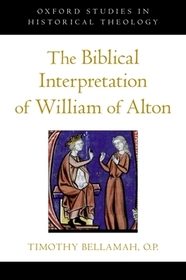
The Biblical Interpretation of William of Alton
Series: Oxford Studies in Historical Theology;
- Publisher's listprice GBP 81.00
-
36 571 Ft (34 830 Ft + 5% VAT)
The price is estimated because at the time of ordering we do not know what conversion rates will apply to HUF / product currency when the book arrives. In case HUF is weaker, the price increases slightly, in case HUF is stronger, the price goes lower slightly.
- Discount 10% (cc. 3 657 Ft off)
- Discounted price 32 914 Ft (31 347 Ft + 5% VAT)
Subcribe now and take benefit of a favourable price.
Subscribe
36 571 Ft

Availability
printed on demand
Why don't you give exact delivery time?
Delivery time is estimated on our previous experiences. We give estimations only, because we order from outside Hungary, and the delivery time mainly depends on how quickly the publisher supplies the book. Faster or slower deliveries both happen, but we do our best to supply as quickly as possible.
Product details:
- Publisher OUP USA
- Date of Publication 3 November 2011
- ISBN 9780199753604
- Binding Hardback
- No. of pages368 pages
- Size 163x239x33 mm
- Weight 641 g
- Language English 0
Categories
Short description:
Timothy Bellamah explores the exegesis of William of Alton, a Dominican regent master at Paris during the thirteenth-century. A near contemporary of Bonaventure, Albert the Great, and Thomas Aquinas, William was an important representative of university exegesis at a time of rapidly changing methods and remarkable intellectual development.
MoreLong description:
Studies of medieval Biblical interpretation usually focus on the printed literature, neglecting the vast majority of relevant works. Timothy Bellamah offers a groundbreaking examination of the exegesis of William of Alton, a thirteenth-century Dominican regent master at Paris whose commentaries have never previously appeared in print.
As a near contemporary of Hugh of St. Cher, Bonaventure, Albert the Great, and Thomas Aquinas, William was an important representative of university exegesis at a time of rapidly changing methods and remarkable intellectual development. His commentaries are valuable resources for understanding Biblical study of the thirteenth century, in the schoolroom and in the pulpit. Yet study of William's work has been impeded by the dubious authenticity of numerous commentaries questionably attributed to him over the centuries.
Bellamah addresses these complex problems by unearthing evidence of authorship in each commentary's style and methodology. This inquiry employs the traits of William's commentaries as criteria for constituting a list of works that can be reliably attributed to him, which, in turn, provides a crucial basis for studying his exegesis. William was a man of his time, but even more than his contemporaries he was deeply interested in history and the literal sense, which he understood to be the intention of Scripture's authors, divine and human. He took a keen interest in Biblical history and put to use a wide array of procedures for textual, linguistic, and rhetorical analysis. At the same time, he remained aware of the spiritual senses and the diverse elements of the exegetical and theological tradition in which he stood.
An ambition book... It reveals an author with an impressive grasp of his field.
Table of Contents:
Preface
Abbreviations
Notes on Style
Introduction
I. William of Alton: An Englishman in Paris
II. Towards a Bibliography: A Few Key Features of William's Methodology and Style
III. William as Exegete
IV. Sources
V. Theological Considerations
Epilogue
Bibliography
APPENDIX I. Consideration of Works Variously Attributed to William
APPENDIX II. Prologues (English and Latin)

