

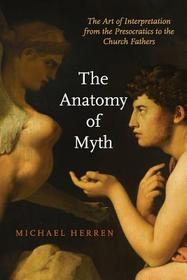
The Anatomy of Myth
The Art of Interpretation from the Presocratics to the Church Fathers
- Publisher's listprice GBP 32.49
-
15 522 Ft (14 782 Ft + 5% VAT)
The price is estimated because at the time of ordering we do not know what conversion rates will apply to HUF / product currency when the book arrives. In case HUF is weaker, the price increases slightly, in case HUF is stronger, the price goes lower slightly.
- Discount 10% (cc. 1 552 Ft off)
- Discounted price 13 969 Ft (13 304 Ft + 5% VAT)
Subcribe now and take benefit of a favourable price.
Subscribe
15 522 Ft

Availability
printed on demand
Why don't you give exact delivery time?
Delivery time is estimated on our previous experiences. We give estimations only, because we order from outside Hungary, and the delivery time mainly depends on how quickly the publisher supplies the book. Faster or slower deliveries both happen, but we do our best to supply as quickly as possible.
Product details:
- Publisher OUP USA
- Date of Publication 21 December 2018
- ISBN 9780190936723
- Binding Paperback
- No. of pages250 pages
- Size 231x155x15 mm
- Weight 408 g
- Language English 0
Categories
Short description:
The Anatomy of Myth is a comprehensive study of the methods of interpreting authoritative myths from the Presocratic philosophers to the Neoplatonists and their adoption by the Church Fathers.
MoreLong description:
The Anatomy of Myth is a comprehensive study of the different methods of interpreting myths developed by the Greeks, adopted by the Romans, and eventually passed on to Jewish and Christian interpreters of the Bible. Greek thinkers only rarely saw "myth" as a category of thought in its own right. Most often they viewed myths as the creation of poets, or else as an ancient revelation that had been corrupted by them. In the first instance, critics attempted to find in the intention of the authors some deeper truth, whether physical or spiritual; in the second, they deemed it necessary to clear away poetic falsehoods in order to recapture an ancient revelation. Parallel to the philosophical critiques were the efforts of early historians to explain myths as exaggerated history; myths could be purified by logos (reason) and rendered believable. Practically all of these early methods could be lumped under the term "allegory"--to intend something different from what one expressed. Only occasionally did philosophers veer from a concern for the literal truth of myths but a few thinkers, while acknowledging myths as fictions, defended their value for the examples of good and bad human behavior they offered. These early efforts were invaluable for the development of critical thinking, enabling public criticism of even the most authoritative texts. The Church Fathers took the interpretative methods of their pagan contemporaries and applied them vigorously to their reading of the scriptures. Pagan Greek methods of myth interpretation passed into the Middle Ages and beyond, serving as a perennial defense against the damaging effects of scriptural literalism and fundamentalism.
The value of Herren's book should not be underestimated, and I unequivocally recommend it to anyone interested in the history of myth and myth criticism. It is easy and enjoyable to read and filled with a fascinating array of information, making connections that shape into clear and compelling arguments. Tracing different threads through centuries of discussion leaves the reader a dynamic overview of not only contributions of classical authors to ways of interpreting or anatomizing myths, but also how these relate to one another, evolve over time, and link to the cultures and historical contexts in which they emerged and progressed.
Table of Contents:
TABLE OF CONTENTS
Abbreviations
Introduction
Chapter 1: The Paradigm of the Poets
Chapter 2: What Makes a Work Authoritative?
Chapter 3: Physis - Redefining the Gods
Chapter 4: Flirting with Atheism
Chapter 5: Attacking Poetry
Chapter 6: The Beginnings of Allegory
Chapter 7: Finding History in Myth
Chapter 8: Theos - Rediscovering God
Chapter 9: The Growth of Allegory
Chapter 10: Saving the Poets without Allegory
Chapter 11: From Allegory to Symbolism
Chapter 12: Greek Exegesis and Judaeo-Christian Books
Reflection
Bibliography
Glossarial Index

