

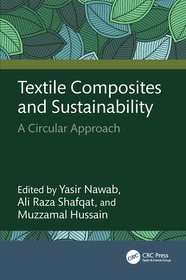
Textile Composites and Sustainability
A Circular Approach
- Publisher's listprice GBP 130.00
-
58 695 Ft (55 900 Ft + 5% VAT)
The price is estimated because at the time of ordering we do not know what conversion rates will apply to HUF / product currency when the book arrives. In case HUF is weaker, the price increases slightly, in case HUF is stronger, the price goes lower slightly.
- Discount 20% (cc. 11 739 Ft off)
- Discounted price 46 956 Ft (44 720 Ft + 5% VAT)
- Discount is valid until: 30 June 2026
Subcribe now and take benefit of a favourable price.
Subscribe
52 826 Ft

Availability
Estimated delivery time: In stock at the publisher, but not at Prospero's office. Delivery time approx. 3-5 weeks.
Not in stock at Prospero.
Why don't you give exact delivery time?
Delivery time is estimated on our previous experiences. We give estimations only, because we order from outside Hungary, and the delivery time mainly depends on how quickly the publisher supplies the book. Faster or slower deliveries both happen, but we do our best to supply as quickly as possible.
Product details:
- Edition number 1
- Publisher CRC Press
- Date of Publication 7 April 2026
- ISBN 9781032978956
- Binding Hardback
- No. of pages270 pages
- Size 234x156 mm
- Weight 660 g
- Language English
- Illustrations 89 Illustrations, black & white; 9 Halftones, black & white; 80 Line drawings, black & white; 17 Tables, black & white 693
Categories
Short description:
This book provides an essential, comprehensive guide to integrating sustainability and circular economy principles specifically within the textile composites sector. It addresses the urgent need for the textile industry to transition from linear to circular models, focusing on waste reduction, resource efficiency, and sustainable innovation.
MoreLong description:
The book Textile Composites and Sustainability: A Circular Approach provides an essential, comprehensive guide to integrating sustainability and circular economy principles specifically within the textile composites sector. This book addresses the urgent need for the textile industry to transition from linear to circular models, focusing on waste reduction, resource efficiency, and sustainable innovation. It covers critical aspects including sustainable material selection, innovative design strategies, advanced manufacturing processes, lifecycle management, and end-of-life recycling techniques tailored to textile composites. Real-world case studies and global perspectives ensure readers gain a holistic understanding of current trends and effective applications of sustainability practices. This book uniquely addresses the distinctive challenges and opportunities inherent in textile composites, making it invaluable for anyone committed to advancing environmental responsibility, enhancing economic sustainability, and fostering innovation within the textile composites sector.
Features:
• Highlights the approaches for innovation, shifting to a circular economy and sustainable development in the field of textile reinforced composites.
• Covers the latest sustainable materials and advancements in textile composites, including natural fibers, biopolymers, and recycled materials.
• Provides practical advice and case studies on circular design concepts and sustainable manufacturing processes.
• Encompasses perspectives from diverse geographic regions and market categories.
This book is aimed at professionals, researchers, and graduate students in textiles, materials, and environmental engineering.
MoreTable of Contents:
1. Introduction. 2. Textile Composites. 3. Fundamentals of Circular Economy. 4. Sustainability in Textile Composites. 5. Raw materials for Sustainable Textile Composites. 6. Design for Circularity.
7. Manufacturing Processes. 8. End-of-Life Management. 9. Economic and Social Dimensions. 10. Case studies of incorporating circularity in composites. 11. Innovation and Future Trends. 12. Conclusion

