

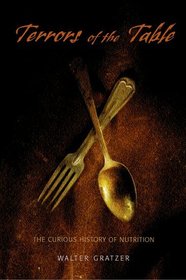
Terrors of the Table
The curious history of nutrition
- Publisher's listprice GBP 17.99
-
8 122 Ft (7 735 Ft + 5% VAT)
The price is estimated because at the time of ordering we do not know what conversion rates will apply to HUF / product currency when the book arrives. In case HUF is weaker, the price increases slightly, in case HUF is stronger, the price goes lower slightly.
- Discount 10% (cc. 812 Ft off)
- Discounted price 7 310 Ft (6 962 Ft + 5% VAT)
Subcribe now and take benefit of a favourable price.
Subscribe
8 122 Ft

Availability
printed on demand
Why don't you give exact delivery time?
Delivery time is estimated on our previous experiences. We give estimations only, because we order from outside Hungary, and the delivery time mainly depends on how quickly the publisher supplies the book. Faster or slower deliveries both happen, but we do our best to supply as quickly as possible.
Product details:
- Publisher OUP Oxford
- Date of Publication 29 September 2005
- ISBN 9780192806611
- Binding Hardback
- No. of pages306 pages
- Size 242x162x29 mm
- Weight 627 g
- Language English
- Illustrations 8 pp halftone plates, 0
Categories
Short description:
Terrors of the Table tells the absorbing story of our struggle to recognise the connections between diet, health, and disease. Gratzer combines the science of nutrition with a colourful history of the fads and quackery that continue to waylay the unwary when it comes to matters of food and health.
MoreLong description:
Terrors of the Table is an absorbing account of the struggle to find the necessary ingredients of a healthy diet, and the fads and quackery that have always waylaid the unwary and the foolish when it comes to the matter of food and health. Walter Gratzer tells the tale of nutrition's heroes, heroines and charlatans with characteristic crispness and verve. We find an array of colourful personalities, from the distinguished but quarrelsome Liebig, to the enterprising Lydia Pinkham. But we also find the slow recognition that the lack of vital ingredients can cause terrible illnesses - scurvy, rickets, beriberi. These diseases stalked the poor in the West even into the 20th century, and scandalously remain in poorer parts of the world today. The narrative stretches from classical times to the modern day and gives a valuable historical perspective to our current understanding. It also highlights some of the problems faced by the developed world regarding health today - in particular diabetes and obesity. And despite our far greater understanding of what our body needs, there are still many who would fall for fads and fancy diets - some dangerous, others just daft.
Of course, the story of nutrition does not end there. We have discovered the key vitamins and minerals our body needs, but research continues on the connections between diet, health and disease. The body's biochemistry is complex, and there are no easy answers, no magic formula, that applies to all individuals. The safest and most rational course would seem to be a sensible, moderate, and varied diet, not forgetting that 'a little of what you fancy does you good'.
'...its breadth and liveliness make this an excellent introduction to the one science that touches all of us daily and intimately.'
Table of Contents:
The Ravages of War
The Scurvy Wars
In the Beginning
Dawn of the Scientific Age
The Savants' Disputes
The Poor, the Rich, the Healthy and the Sick
Cheats and Poisoners
Paradigm Postponed: The Tardy Arrival of Vitamins
The Quarry Run to Earth
Fads and Quacks
The New Millennium: Profits and the higher quackery
Appendix: The hard science

