

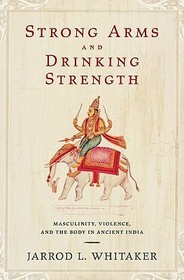
Strong Arms and Drinking Strength
Masculinity, Violence, and the Body in Ancient India
- Publisher's listprice GBP 110.00
-
49 665 Ft (47 300 Ft + 5% VAT)
The price is estimated because at the time of ordering we do not know what conversion rates will apply to HUF / product currency when the book arrives. In case HUF is weaker, the price increases slightly, in case HUF is stronger, the price goes lower slightly.
- Discount 10% (cc. 4 967 Ft off)
- Discounted price 44 699 Ft (42 570 Ft + 5% VAT)
Subcribe now and take benefit of a favourable price.
Subscribe
49 665 Ft

Availability
printed on demand
Why don't you give exact delivery time?
Delivery time is estimated on our previous experiences. We give estimations only, because we order from outside Hungary, and the delivery time mainly depends on how quickly the publisher supplies the book. Faster or slower deliveries both happen, but we do our best to supply as quickly as possible.
Product details:
- Publisher OUP USA
- Date of Publication 28 April 2011
- ISBN 9780199755707
- Binding Hardback
- No. of pages240 pages
- Size 236x163x22 mm
- Weight 499 g
- Language English 0
Categories
Short description:
Jarrod Whitaker examines the ritualized poetic construction of male identity in the Rigveda, India's oldest Sanskrit text, arguing that an important aspect of early Vedic life involves the sustained promotion and embodiment of what it means to be a true man.
MoreLong description:
Jarrod L. Whitaker examines the ritualized poetic construction of male identity in the Rgveda, India's oldest Sanskrit text, arguing that an important aspect of early Vedic life was the sustained promotion and embodiment of what it means to be a true man. The Rgveda contains over a thousand hymns, addressed primarily to three gods: the deified ritual Fire, Agni; the war god, Indra; and Soma, who is none other than the personification of the sacred beverage sóma. The hymns were sung in day-long fire rituals in which poet-priests prepared the sacred drink to empower Indra. The dominant image of Indra is that of a highly glamorized, violent, and powerful Aryan male; the three gods represent the ideals of manhood.
Whitaker finds that the Rgvedic poet-priests employed a fascinating range of poetic and performative strategies--some explicit, others very subtle--to construct their masculine ideology, while justifying it as the most valid way for men to live. Poet-priests naturalized this ideology by encoding it within a man's sense of his body and physical self. Rgvedic ritual rhetoric and practices thus encode specific male roles, especially the role of man as warrior, while embedding these roles in a complex network of social, economic, and political relationships.
Strong Arms and Drinking Strength is the first book in English to examine the relationship between Rgvedic gods, ritual practices, and the identities and expectations placed on men in ancient India.
This important book cuts sensitively to the core of the construction of masculinity in Vedic family, clan, and tribal society. From early hymns that reflect expansion through seasonal migrations to the hegemonic patriarchy embodied in state formation that closes the Rgvedic canon, Whitaker details a consistent androcentric ideology that lauds strength, intimidation, and violence through images of the hyper-masculine body and soma drinking of the god Indra. A needed but rare convergence of philology with gender, body, and ritual studies.
Table of Contents:
Introduction
Chapter 1: Manhood and Masculinity
Chapter 2: Brave Men and Bravery
Chapter 3: Champions, Obstacles, and the Dragon
Chapter 4: Strong Arms and Drinking Strength
Conclusion
Bibliography

