

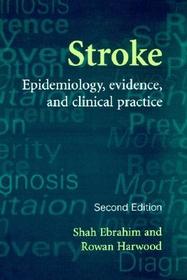
Stroke
Epidemiology, Evidence and Clinical Practice
- Publisher's listprice GBP 74.00
-
33 411 Ft (31 820 Ft + 5% VAT)
The price is estimated because at the time of ordering we do not know what conversion rates will apply to HUF / product currency when the book arrives. In case HUF is weaker, the price increases slightly, in case HUF is stronger, the price goes lower slightly.
- Discount 15% (cc. 0 Ft off)
- Discounted price 28 399 Ft (27 047 Ft + 5% VAT)
- Discount is valid until: 5 August 2026
Subcribe now and take benefit of a favourable price.
Subscribe
33 411 Ft

Availability
printed on demand
Why don't you give exact delivery time?
Delivery time is estimated on our previous experiences. We give estimations only, because we order from outside Hungary, and the delivery time mainly depends on how quickly the publisher supplies the book. Faster or slower deliveries both happen, but we do our best to supply as quickly as possible.
Product details:
- Edition number 2
- Publisher OUP Oxford
- Date of Publication 5 August 1999
- ISBN 9780192630759
- Binding Paperback
- No. of pages356 pages
- Size 234x156x19 mm
- Weight 510 g
- Language English
- Illustrations 19 line figures 0
Categories
Short description:
There has been an explosion of research on stroke in the decade since the publication of the first edition of this book. Increasingly, with vast amounts of data becoming available from clinical trials, clinicians need guidance on the clinical epidemiology, diagnosis, management and prognosis of stroke. This edition is a substantially updated and expanded work and discusses the evidence-base for health care in stroke.
MoreLong description:
Almost a decade has passed since the first edition of this book was published and the explosion of new research in stroke is very apparent. Several important themes have coloured medicine during this time: the development of evidence based health care, new optimism for acute drug treatments for stroke, the growth of new information about the human genome, a dramatic increase in the number of stroke clinicians and researchers world-wide, and the establishment of the Cochrane Collaboration. All of these trends are relevant in revising a book of this nature. Clinical epidemiology remains an essential foundation for the practice of evidence-based healthcare. The enthusiasm of the pharmaceutical industry has resulted in a large number of new trials, often too small to detect clinically important differences, and have increased the number of clinicians actively engaged in stroke research. It is even more important that these clinicians should have a good understanding of the design of trials, the rationale for randomisation and blinding, and the importance of selecting the most appropriate outcomes. Surprisingly, little of practical importance has resulted from the decade of exploration of the human genome - the best indication of a person's risk remains their phenotype and not their genotype. The impetus to organise stroke medicine into a defined speciality, with emphasis on acute stroke, is even stronger - but it is essential to bear in mind the importance of interdisciplinary working, the value of primary care, geriatric medicine, psychiatry and rehabilitation in the prevention, treatment rehabilitation and long-term care of stroke patients. The Cochrane Collaboration is currently grappling with a task of enormous size - the compression of tens of thousands of randomised control trials -and other scientific evidence- into systematic reviews of the effects of interventions. Citations to this work are made in the section on management. In this edition, there is an extra opening section entitled Epidemiology which comprises the nuts and bolts of the subject and reviews the purposes of health care for stroke patients. The remaining sections follow the format of the first edition: Diagnosis, Management, and Prognosis. All chapters have been substantially updated. The book retains its focus on epidemiology that is relevant to the clinician and attempts to use examples from stroke to illustrate many aspects of epidemiological thinking. The book aims to stimulate readers to think about their own practice, the nature of scientific evidence and the vast areas of clinical uncertainty that remain the target for research over the coming decades.
MoreTable of Contents:
Foreword by Charles Warlow
Part 1: EPIDEMIOLOGY
Objectives of stroke care
Risk and risk factors
Time, places and people
Summary
Part 2: DIAGNOSIS
Diagnosis
Clinical Disagreement
Investigation
Severity
Summary
Part 3: MANAGEMENT
Prevention
Acute Management
Rehabilitation
Preventing recurrence
Summary
Part 4: PROGNOSIS
Mortality
Recurrence
Effects of Stroke
Recovery
Summary
References
Index

