

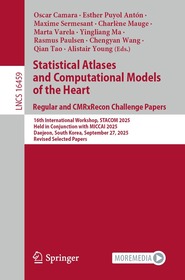
Statistical Atlases and Computational Models of the Heart. Regular and CMRxRecon Challenge Papers
16th International Workshop, STACOM 2025, Held in Conjunction with MICCAI 2025, Daejeon, South Korea, September 27, 2025, Revised Selected Papers
Series: Lecture Notes in Computer Science;
- Publisher's listprice EUR 87.73
-
34 267 Ft (32 635 Ft + 5% VAT)
The price is estimated because at the time of ordering we do not know what conversion rates will apply to HUF / product currency when the book arrives. In case HUF is weaker, the price increases slightly, in case HUF is stronger, the price goes lower slightly.
- Discount 20% (cc. 6 853 Ft off)
- Discounted price 27 413 Ft (26 108 Ft + 5% VAT)
- Discount is valid until: 30 June 2026
Subcribe now and take benefit of a favourable price.
Subscribe
30 155 Ft

Availability
Not yet published.
Why don't you give exact delivery time?
Delivery time is estimated on our previous experiences. We give estimations only, because we order from outside Hungary, and the delivery time mainly depends on how quickly the publisher supplies the book. Faster or slower deliveries both happen, but we do our best to supply as quickly as possible.
Product details:
- Publisher Springer Nature Switzerland
- Date of Publication 19 May 2026
- ISBN 9783032177339
- Binding Paperback
- No. of pages357 pages
- Size 235x155 mm
- Language English
- Illustrations XII, 357 p. 120 illus., 110 illus. in color. 700
Categories
Long description:
"
This book constitutes the proceedings of the 16th International Workshop on Statistical Atlases and Computational Models of the Heart, STACOM 2025, held in conjunction with the 28th International Conference on Medical Image Computing and Computer Assisted Intervention, MICCAI 2025, in Daejeon, South Korea on September 27, 2025
The 26 full workshop papers included in this book were carefully reviewed and selected from 32 submissions. The CMRxRecon Challenge received 22 paper submissions of which 8 are included in this book. They deal with cardiac segmentation, modelling, motion estimation, statistical shape analysis, and quality control. Deep learning methods were still the predominant approach to performing automated cardiac image analysis. Left atrial image analysis and modelling gained more attention in this workshop, with atrial fibrillation being the common area of interest.
" More
