

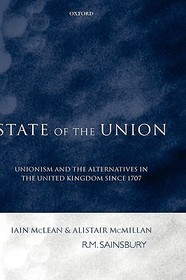
State of the Union
Unionism and the Alternatives in the United Kingdom Since 1707
- Publisher's listprice GBP 142.50
-
64 338 Ft (61 275 Ft + 5% VAT)
The price is estimated because at the time of ordering we do not know what conversion rates will apply to HUF / product currency when the book arrives. In case HUF is weaker, the price increases slightly, in case HUF is stronger, the price goes lower slightly.
- Discount 10% (cc. 6 434 Ft off)
- Discounted price 57 905 Ft (55 148 Ft + 5% VAT)
Subcribe now and take benefit of a favourable price.
Subscribe
64 338 Ft

Availability
printed on demand
Why don't you give exact delivery time?
Delivery time is estimated on our previous experiences. We give estimations only, because we order from outside Hungary, and the delivery time mainly depends on how quickly the publisher supplies the book. Faster or slower deliveries both happen, but we do our best to supply as quickly as possible.
Product details:
- Publisher OUP Oxford
- Date of Publication 29 September 2005
- ISBN 9780199258208
- Binding Hardback
- No. of pages304 pages
- Size 242x164x22 mm
- Weight 608 g
- Language English
- Illustrations numerous line drawings and tables 0
Categories
Short description:
This is a major new examination of Unionism in the UK. These two leading scholars draw on fresh analyses, based on both political leaders and ordinary people, to demonstrate how the concept of Unionism has driven UK politics since the eighteenth century. As the United Kingdom stands on the brink of devolution, this book provides a timely examination of exactly where Unionism has led.
MoreLong description:
This is the first survey of Unionism, the ideology of most of the rulers of the United Kingdom for the last 300 years. Because it was taken so much for granted, it has never been properly studied. Now that we stand in the twilight of Unionism, it is possible to see it as it casts its long shadow over British and imperial history since 1707.
The book looks at all the crucial moments in the history of Unionism. In 1707, the parliaments and (more important) executives of England and Scotland were united. During the 18th century, although not immediately after 1707, that union blossomed and brought benefits to both parties. It facilitated the first and second British Empires. The Union of Great Britain and Ireland in 1800-01 was formally similar but behaviourally quite different. It was probably doomed from the start when George III refused to accept Catholic Emancipation. Nevertheless, no leading British politician heeded the Irish clamour for Home Rule until Gladstone in 1886. That cataclysmic year has determined the shape of British and Irish politics ever since. Having refused to concede Irish Home Rule through the heyday of primordial Unionism from 1886 to 1920, British politicians had to accept Irish independence in 1921, whereupon primordial Unionism fell apart except in Northern Ireland. Twentieth-century Unionism has been instrumental - valuing the Union for its consequences, not because it was intrinsically good.
As Unionism was inextricably tied up with the British Empire, it nevertheless remained as a strong but unexamined theme until the end of Empire. The unionist parties (Conservative and Labour) responded to the upsurge of Scottish and Welsh nationalism, and of violence in Northern Ireland, in the light of their mostly unexamined unionism in the 1960s. With the departure from politics of the last Unionists (Enoch Powell and John Major), British politics is now subtly but profoundly different.
Iain McLean and Alistair MacMillan provide the heavyweight academic background to [the] ferment of comment and controvesy, especially since McLean - the professor of politics at Oxford University - has been a long-term thinker about such matters.
Table of Contents:
The United Kingdom as a Union State
The Union of Westminster and Edinburgh Parliaments 1707
Ireland's Incorporation: An 'Excusable Mistake'?
1886
The High Noon of Unionism - 1886-1921
Ulster Unionism Since 1921
Unionism Since 1961: Elite Attitudes
Unionism Since 1961: Mass Attitudes
Representation in a Union State
Public Finance in an Asymmetric Union
Conclusion: A Union State Without Unionism
Appendix: Principal Characters in 1707 and 1800

