

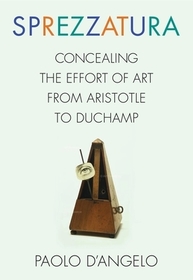
Sprezzatura
Concealing the Effort of Art from Aristotle to Duchamp
- Publisher's listprice GBP 28.00
-
12 642 Ft (12 040 Ft + 5% VAT)
The price is estimated because at the time of ordering we do not know what conversion rates will apply to HUF / product currency when the book arrives. In case HUF is weaker, the price increases slightly, in case HUF is stronger, the price goes lower slightly.
- Discount 10% (cc. 1 264 Ft off)
- Discounted price 11 378 Ft (10 836 Ft + 5% VAT)
Subcribe now and take benefit of a favourable price.
Subscribe
12 642 Ft

Availability
Estimated delivery time: In stock at the publisher, but not at Prospero's office. Delivery time approx. 3-5 weeks.
Not in stock at Prospero.
Why don't you give exact delivery time?
Delivery time is estimated on our previous experiences. We give estimations only, because we order from outside Hungary, and the delivery time mainly depends on how quickly the publisher supplies the book. Faster or slower deliveries both happen, but we do our best to supply as quickly as possible.
Product details:
- Publisher Columbia University Press
- Date of Publication 10 April 2018
- ISBN 9780231175821
- Binding Hardback
- No. of pages192 pages
- Size 225x140x17 mm
- Weight 382 g
- Language English 0
Categories
Long description:
In this book, the first to consider sprezzatura in its own right, philosopher of art Paolo D'Angelo reconstructs the history of concealing art, from ancient rhetoric to our own times. The word sprezzatura was coined in 1528 by Baldassarre Castiglione in The Book of the Courtier to mean a kind of grace with a special essence: the ability to conceal art. But the idea reaches back to Aristotle and Cicero and forward to avant-garde works such as Duchamp's ready-mades, all of which share the suspicion of the overt display of skill. The precept that art must be hidden turns up in a number of fields, from cosmetics to interior design, politics to poetry, the English garden to shabby chic. Through exploring different articulations of this idea, D'Angelo shows the paradox of aesthetics: art hides that it is art, but in doing so it reveals itself to be art and becomes an assertion about art.
A brilliant and lively essay on a fundamental aesthetic concept. Broad-ranging both philosophically and historically, the author treats the wit and paradox of explaining a rhetorical and performative action of speech or art-making that must conceal its artfulness for the sake of beauty, eloquence, and grace. Lydia Goehr, Columbia University

