

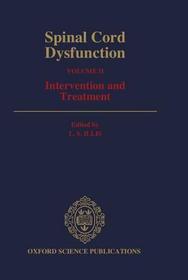
Spinal Cord Dysfunction: Volume II: Intervention and Treatment
- Publisher's listprice GBP 145.00
-
65 467 Ft (62 350 Ft + 5% VAT)
The price is estimated because at the time of ordering we do not know what conversion rates will apply to HUF / product currency when the book arrives. In case HUF is weaker, the price increases slightly, in case HUF is stronger, the price goes lower slightly.
- Discount 10% (cc. 6 547 Ft off)
- Discounted price 58 921 Ft (56 115 Ft + 5% VAT)
Subcribe now and take benefit of a favourable price.
Subscribe
65 467 Ft

Availability
printed on demand
Why don't you give exact delivery time?
Delivery time is estimated on our previous experiences. We give estimations only, because we order from outside Hungary, and the delivery time mainly depends on how quickly the publisher supplies the book. Faster or slower deliveries both happen, but we do our best to supply as quickly as possible.
Product details:
- Edition number and title :Volume II: Intervention and Treatment
- Publisher OUP Oxford
- Date of Publication 12 December 1991
- ISBN 9780192617873
- Binding Hardback
- No. of pages240 pages
- Size 238x163x18 mm
- Weight 514 g
- Language English
- Illustrations halftones, line illustrations, tables 0
Categories
Short description:
This is the second in a series of books dealing with the enormous clinical problem of spinal cord dysfunction. Volume I discussed assessment; this book focuses on intervention. There are three main approaches to the restoration of function after damage to the spinal cord: the prevention of secondary pathological events; the identification of impaired or absent functions in nerve cells and processes that survive the initial insult; and restoration of severed neuronal connections. This book addresses the first two of these approaches. The management of specific problems associated with spinal cord dysfunction is also addressed and current procedures of rehabilitation (particularly the management of chronic problems and the treatment of complications) are summarized. Ideas on motor control and learning are discussed.
MoreLong description:
This is the second in a series of books dealing with the enormous clinical problem of spinal cord dysfunction. Volume I discussed assessment; this book focuses on intervention. There are three main approaches to the restoration of function after damage to the spinal cord: the prevention of secondary pathological events; the identification of impaired or absent functions in nerve cells and processes that survive the initial insult; and restoration of severed neuronal connections. This book addresses the first two of these approaches. It contains a discussion of the arguments about early decompression of the spinal cord following injury, therapy of acute spinal injury, and the effects of early treatment and local cooling on spinal cord blood flow. The management of specific problems associated with spinal cord dysfunction is addressed; these problems include cardiovascular abnormalities due to autonomic dysfunction, bladder control, pain, and sexual function. Current procedures of rehabilitation (particularly the management of chronic problems and the treatment of complications) are summarized, and ideas on motor control and learning are discussed.
'These topics are not readily available elsewhere within one text and consequently will provide a valuable resource of information. ... this volume is a useful reference and resource for therapists working in this field.'
Dorothy Tusslet, Physiotherapy, October 1992
Table of Contents:
L.S. Illis: Introduction; I- THE ACUTE PHASE: W.S. El Masri & D.V. Meerkotter: Early decompression of the spinal cord following injury: arguments for and against; Wise Young: Therapy of acute spinal cord injury; Robert R. Hansebout: Spinal injury and spinal cord blood flow: the effect of early treatment and local cooling; II- SPECIFIC PROBLEMS: L.S. Illis: Introduction; L.S. Illis: Spasticity I: Clinical aspects; E.M. Sedgewick & J. Benfield: Spasticity II: Physiological measurements; C.J. Mathias, H.R. Frankel, & J.D. Cole: Management of cardiovascular abnormalities caused by autonomic dysfunction in spinal cord injury; G.J. Fellows: Bladder management; L.S. Illis: Central pain; Aleksandar Beric: Pain in spinal cord injury; B.P. Gardner & P. Rainsbury: Sexual function following spinal cord injury; Theo Mulder: Current ideas on motor control and learning: implications for therapy; III- BEHAVIOURAL THERAPY: L.S. Illis: Rehabilitation.
More
