

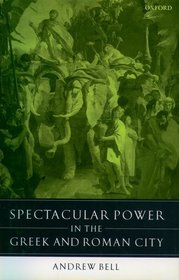
Spectacular Power in the Greek and Roman City
- Publisher's listprice GBP 175.00
-
79 012 Ft (75 250 Ft + 5% VAT)
The price is estimated because at the time of ordering we do not know what conversion rates will apply to HUF / product currency when the book arrives. In case HUF is weaker, the price increases slightly, in case HUF is stronger, the price goes lower slightly.
- Discount 10% (cc. 7 901 Ft off)
- Discounted price 71 111 Ft (67 725 Ft + 5% VAT)
Subcribe now and take benefit of a favourable price.
Subscribe
79 012 Ft

Availability
printed on demand
Why don't you give exact delivery time?
Delivery time is estimated on our previous experiences. We give estimations only, because we order from outside Hungary, and the delivery time mainly depends on how quickly the publisher supplies the book. Faster or slower deliveries both happen, but we do our best to supply as quickly as possible.
Product details:
- Publisher OUP Oxford
- Date of Publication 30 September 2004
- ISBN 9780199242344
- Binding Hardback
- No. of pages304 pages
- Size 224x146x22 mm
- Weight 490 g
- Language English 0
Categories
Short description:
In the great cities of Greece and Rome, politicians and kings sought to be seen as celebrities. They tried to appear wondrous and exciting to citizens and subjects. This study shows some of their methods and so reveals the importance of political advertisement and spectacle in societies that saw great kings but also pioneered democracy and republicanism.
MoreLong description:
Andrew Bell's analysis of the power of prestige in civic communities of the ancient world demonstrates the importance of crowds' aesthetic and emotional judgement upon leaders and their ambitious claims for immediate and lasting significance; and also finds consideration of this dynamic still to be valuable for modern citizens. An initial discussion of the fall of Ceausescu in 1989 prompts theoretical considerations about the inseparability of authority and its manifestation; and scrutiny of Julius Caesar's gestures towards self-definition introduces the complexity of ancient political relations. The simultaneous presence of both popular affection for wondrous and kingly individuals, and also egalitarian suspicion of it, is detected in classical Athens, where an Alcibiades needed to manoeuvre craftily to achieve obvious and ritual pre-eminence in associating himself with age-old and Homeric models of distinction. Accordingly, the arrival of Hellenistic kingliness, such as that of Demetrios Poliorcetes, upon the political stage was neither wholly innovative nor unattractive. Yet such kings quite clearly articulated a new and grandiose majesty, as can be seen in parades in Egypt and Syria. With the growth of Roman imperialism, these stylings of personal power needed to be adapted to new realities and models, just as Romans of the later Republic increasingly found much to admire and emulate in others' spectacles. Thus the book comes back to the end of the Republic and to Cicero's struggles to maintain traditional, republican dignities in civic ceremony while a new Roman kingliness, thoroughly attentive to spectacular politics, was dawning.
offers some genuinely interesting insights into the division of power between prominent politicans and their audiences in ancient cities... B.'s book makes a valuable contribution to the study of power relations in ancient communities
Table of Contents:
Looking at the Powerful
Looking at Caesar
The Affections of the Athenians
Kings and Elephants
Elephants and Citizens
Ciceronian Consensus
Afterword

