

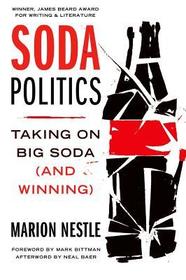
Soda Politics
Taking on Big Soda (And Winning)
- Publisher's listprice GBP 19.49
-
8 799 Ft (8 380 Ft + 5% VAT)
The price is estimated because at the time of ordering we do not know what conversion rates will apply to HUF / product currency when the book arrives. In case HUF is weaker, the price increases slightly, in case HUF is stronger, the price goes lower slightly.
- Discount 10% (cc. 880 Ft off)
- Discounted price 7 919 Ft (7 542 Ft + 5% VAT)
Subcribe now and take benefit of a favourable price.
Subscribe
8 799 Ft

Availability
printed on demand
Why don't you give exact delivery time?
Delivery time is estimated on our previous experiences. We give estimations only, because we order from outside Hungary, and the delivery time mainly depends on how quickly the publisher supplies the book. Faster or slower deliveries both happen, but we do our best to supply as quickly as possible.
Product details:
- Publisher OUP USA
- Date of Publication 26 October 2017
- ISBN 9780190693145
- Binding Paperback
- No. of pages526 pages
- Size 226x145x33 mm
- Weight 635 g
- Language English
- Illustrations 130 illustrations 0
Categories
Short description:
How did products containing absurdly inexpensive ingredients become multibillion dollar industries and international brand icons, while also having a devastating impact on public health? In Soda Politics, Dr. Marion Nestle, a renowned food and nutrition policy expert and public health advocate, answers this question by detailing all of the ways that the soft drink industry works overtime to make drinking soda as common and accepted as drinking water, for adults and children.
MoreLong description:
Sodas are astonishing products. Little more than flavored sugar-water, these drinks cost practically nothing to produce or buy, yet have turned their makers--principally Coca-Cola and PepsiCo--into a multibillion-dollar industry with global recognition, distribution, and political power. Billed as "refreshing," "tasty," "crisp," and "the real thing," sodas also happen to be so well established to contribute to poor dental hygiene, higher calorie intake, obesity, and type-2 diabetes that the first line of defense against any of these conditions is to simply stop drinking them. Habitually drinking large volumes of soda not only harms individual health, but also burdens societies with runaway healthcare costs.
So how did products containing absurdly inexpensive ingredients become multibillion dollar industries and international brand icons, while also having a devastating impact on public health?
In Soda Politics, the 2016 James Beard Award for Writing & Literature Winner, Dr. Marion Nestle answers this question by detailing all of the ways that the soft drink industry works overtime to make drinking soda as common and accepted as drinking water, for adults and children. Dr. Nestle, a renowned food and nutrition policy expert and public health advocate, shows how sodas are principally miracles of advertising; Coca-Cola and PepsiCo spend billions of dollars each year to promote their sale to children, minorities, and low-income populations, in developing as well as industrialized nations. And once they have stimulated that demand, they leave no stone unturned to protect profits. That includes lobbying to prevent any measures that would discourage soda sales, strategically donating money to health organizations and researchers who can make the science about sodas appear confusing, and engaging in Corporate Social Responsibility (CSR) activities to create goodwill and silence critics. Soda Politics follows the money trail wherever it leads, revealing how hard Big Soda works to sell as much of their products as possible to an increasingly obese world.
But Soda Politics does more than just diagnose a problem--it encourages readers to help find solutions. From Berkeley to Mexico City and beyond, advocates are successfully countering the relentless marketing, promotion, and political protection of sugary drinks. And their actions are having an impact--for all of the hardball and softball tactics the soft drink industry employs to maintain the status quo, soda consumption has been flat or falling for years. Health advocacy campaigns are now the single greatest threat to soda companies' profits. Soda Politics provides readers with the tools they need to keep up pressure on Big Soda in order to build healthier and more sustainable food systems.
2016 James Beard Award for Writing & Literature Winner
Table of Contents:
Foreword, by Mark Bittman
Introduction
What is soda and why should anyone care?
1) Sodas: the inside story
2) Soda drinkers: facts and figures
3) The sugar(s) problem
Sodas and health
4) Dietary advice: sugars and sugary drinks
5) The health issues: obesity, diabetes, and more
6) Advocating health: soda-free teeth
The soda industry and how it works
7) Meet Big Soda: an overview
8) Obesity: Big Soda's response
9) Marketing sugary drinks: four basic principles
Targeting children
10) Starting early: Marketing to infants, children, and teens
11) Advocating health: Ending soda marketing to kids
12) Advocating health: Getting sodas out of schools
13) Advocating health: Getting kids involved
Targeting minorities and the poor
14) Marketing to African- and Hispanic-Americans: a complicated story
15) Selling to the developing world
16) Advocating health: excluding sodas from SNAP
Playing softball: Recruiting allies, coopting critics
17) "Softball" marketing strategies: Corporate Social Responsibility
18) Investing in communities
19) Supporting worthy causes: health professionals and research
20) Recruiting public health leaders
Playing softball: Mitigating soda-induced environmental damage
21) Advocating sustainability: defending the environment
22) Advocating sustainability: protecting public water resources
Playing hardball: defending turf, attacking critics
23) Lobbying, campaign contributions, and the revolving door
24) Using public relations and front groups
Taking action: soda caps and taxes
25) Advocating health: capping soda portion sizes
26) Advocating health: taxing sugary drinks
27) Advocating for health and the environment: take action
Afterword, by Neal Baer
Appendix I: The principal US groups advocating for healthier beverage choices
Appendix II: National, state, and local campaigns to reduce soda consumption: selected examples
Selected bibliography
List of tables and figures
Reference notes
Acknowledgments
Index

