

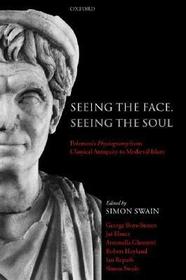
Seeing the Face, Seeing the Soul
Polemon's Physiognomy from Classical Antiquity to Medieval Islam
- Publisher's listprice GBP 260.00
-
117 390 Ft (111 800 Ft + 5% VAT)
The price is estimated because at the time of ordering we do not know what conversion rates will apply to HUF / product currency when the book arrives. In case HUF is weaker, the price increases slightly, in case HUF is stronger, the price goes lower slightly.
- Discount 10% (cc. 11 739 Ft off)
- Discounted price 105 651 Ft (100 620 Ft + 5% VAT)
Subcribe now and take benefit of a favourable price.
Subscribe
117 390 Ft

Availability
printed on demand
Why don't you give exact delivery time?
Delivery time is estimated on our previous experiences. We give estimations only, because we order from outside Hungary, and the delivery time mainly depends on how quickly the publisher supplies the book. Faster or slower deliveries both happen, but we do our best to supply as quickly as possible.
Product details:
- Publisher OUP Oxford
- Date of Publication 8 March 2007
- ISBN 9780199291533
- Binding Hardback
- No. of pages712 pages
- Size 242x165x44 mm
- Weight 1179 g
- Language English
- Illustrations 4 figures, 7 halftones 0
Categories
Short description:
Polemon of Laodicea's Physiognomy explains how to detect someone's character from their appearance. The original 2nd-century text has been lost, but this collection of essays presents translations of the surviving Greek, Latin, and Arabic versions together with a series of masterly studies on the Physiognomy's origins, function, and legacy.
MoreLong description:
Polemon of Laodicea (near modern Denizli, south-west Turkey) was a wealthy Greek aristocrat and a key member of the intellectual movement known as the Second Sophistic. Among his works was the Physiognomy, a manual on how to tell character from appearance, thus enabling its readers to choose friends and avoid enemies on sight. Its formula of detailed instruction and personal reminiscence proved so successful that the book was re-edited in the fourth century by Adamantius in Greek, translated and adapted by an unknown Latin author of the same era, and translated in the early Middle Ages into Syriac and Arabic. The surviving versions of Adamantius, Anonymus Latinus, and the Leiden Arabic more than make up for the loss of the original.
The present volume is the work of a team of leading Classicists and Arabists. The main surviving versions in Greek and Latin are translated into English for the first time. The Leiden Arabic translation is authoritatively re-edited and translated, as is a sample of the alternative Arabic Polemon. The texts and translations are introduced by a series of masterly studies that tell the story of the origins, function, and legacy of Polemon's work, a legacy especially rich in Islam. The story of the Physiognomy is the story of how one man's obsession with identifying enemies came to be taken up in the fascinating transmission of Greek thought into Arabic.
A huge effort...has gone into this beautifully produced, collaborative project on ancient Greek physiognomy and its reception in medieval Islamic society.
Table of Contents:
Introduction
I. Antiquity
Physiognomy and Ancient Psychological Theory
Polemon's Physiognomy
Physiognomics: Art and Text
II. Islam
The Islamic Background to Polemon's Treatise
The Semiotic Paradigm: Physiognomy and Medicine in Islamic Culture
Polemon's Physiognomy in the Arabic Tradition
III. Texts and Translations
A New Edition and Translation of the Leiden Polemon
The Istanbul Polemon (TK Recension): Edition and Translation of the Introduction
The Physiognomy of Adamantius the Sophist
Anonymus Latinus, Book of Physiognomy

