

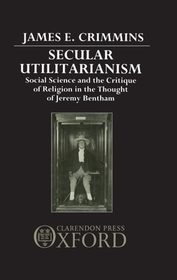
Secular Utilitarianism
Social Science and the Critique of Religion in the Thought of Jeremy Bentham
- Publisher's listprice GBP 83.00
-
37 474 Ft (35 690 Ft + 5% VAT)
The price is estimated because at the time of ordering we do not know what conversion rates will apply to HUF / product currency when the book arrives. In case HUF is weaker, the price increases slightly, in case HUF is stronger, the price goes lower slightly.
- Discount 10% (cc. 3 747 Ft off)
- Discounted price 33 727 Ft (32 121 Ft + 5% VAT)
Subcribe now and take benefit of a favourable price.
Subscribe
37 474 Ft

Availability
printed on demand
Why don't you give exact delivery time?
Delivery time is estimated on our previous experiences. We give estimations only, because we order from outside Hungary, and the delivery time mainly depends on how quickly the publisher supplies the book. Faster or slower deliveries both happen, but we do our best to supply as quickly as possible.
Product details:
- Publisher Clarendon Press
- Date of Publication 14 June 1990
- ISBN 9780198277415
- Binding Hardback
- No. of pages360 pages
- Size 223x147x26 mm
- Weight 586 g
- Language English 0
Categories
Long description:
Jeremy Bentham was an ardent secularist convinced that society could be sustained without the support of religious institutions or beliefs. This is writ large in the commonly neglected books on religion he wrote and published during the last twenty-five years of his life. However his earliest writings on the subject date from the 1770s, when as a young man he first embarked on his calling as a legal theorist and social reformer. From that time on, religion was never far from the centre of his thoughts.
In Secular Utilitarianism, James Crimmins illustrates the nature, extent, and depth of Jeremy Bentham's concern with religion, from his Oxford days of first doubts to the middle years of quiet unbelief, and finally, the zealous atheism and secularism of his later life. Dr Crimmins provides an interpretation of Bentham's thought in which his religious views, hitherto of little interest to Bentham scholars, are shown to be integral: on the one hand intimately associated with the metaphysical, epistemological, and psychological principles which gave shape to his system as a whole, and on the other central to the development of his entirely secular view of society.
'well-researched, meticulous, reliable and full of information'
Times Higher Education Supplement

