

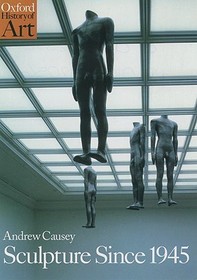
Sculpture Since 1945
Series: Oxford History of Art;
- Publisher's listprice GBP 24.49
-
11 057 Ft (10 530 Ft + 5% VAT)
The price is estimated because at the time of ordering we do not know what conversion rates will apply to HUF / product currency when the book arrives. In case HUF is weaker, the price increases slightly, in case HUF is stronger, the price goes lower slightly.
- Discount 10% (cc. 1 106 Ft off)
- Discounted price 9 951 Ft (9 477 Ft + 5% VAT)
Subcribe now and take benefit of a favourable price.
Subscribe
11 057 Ft

Availability
printed on demand
Why don't you give exact delivery time?
Delivery time is estimated on our previous experiences. We give estimations only, because we order from outside Hungary, and the delivery time mainly depends on how quickly the publisher supplies the book. Faster or slower deliveries both happen, but we do our best to supply as quickly as possible.
Product details:
- Publisher OUP Oxford
- Date of Publication 30 April 1998
- ISBN 9780192842053
- Binding Paperback
- No. of pages304 pages
- Size 238x168x18 mm
- Weight 570 g
- Language English
- Illustrations colour and black and white halftones throughout 0
Categories
Short description:
In recent decades sculpture has arguably become the dominant art form in the world. In this ground-breaking account of the development of post-War sculpture Andrew Causey examines innovative and avant-garde works in relation to contemporary events, festivals, commissions, the marketplace, and the changing functions of museums. He explores the use of everyday objects and the importance of sculptural context, discussing figurative and non-figurative works, Anti-form, Minimalism, experimental form, Earth Art, landscape sculpture, installation, and Performance Art. The holistic picture of post-War sculpture which emerges establishes for the first time the key events and themes round which future debate will centre.
`Andrew Causey weaves his way adroitly through the labyrinth of post-War sculpture ... No one else has charted the territory so comprehensively.'
Professor Stephen Bann, University of Kent at Canterbury
`a clear guide to the various directions of sculpture and the work of sculptors in the years when modern sculpture has begun to stand in its own right as a major art form'
Sir Anthony Caro, Sculptor
Long description:
Since 1945 the modern revolution in sculpture has gathered pace, and sculpture has now ceased to be the fixed category it once was. In recent decades the modernist idea of sculpture across the UK, America, and Europe, has been challenged, and issues such as nationalityand politics have been brought in to the arena of public discussion.
In this ground-breaking account of the development of post-War sculpture Andrew Causey examines innovative and avant-garde works in relation to contemporary events, festivals, commissions, the marketplace, and the changing functions of museums. He explores the use of everyday objects and the importance of sculptural context, discussing figurative and non-figurative works, Anti-form, Minimalism, experimental form, Earth Art, landscape sculpture, installation, and Performance Art. The holistic picture of post-War sculpture which emerges establishes for the first time the key events and themes round which future debate will centre.
From the pre-publication reviews:
Andrew Causey weaves his way adroitly through the labyrinth of post-War sculpture ... No one else has charted the territory so comprehensively |s Professor Stephen Bann, University of Kent at Canterbury
stimulating and persuasive ... balances a searching analysis of the impact of institutional change, issues of sites and environment, and key critical debates with revealing commentaries on individual artists and works of art ... a discerning guide for anyone interested in contemporary art and culture. |s Elizabeth Cowling, University of Edinburgh
a clear guide to the various directions of sculpture and the work of sculptors in the years when modern sculpture has begun to stand in its own right as a major art form. |s Sir Anthony Caro, Sculptor
Andrew Causey weaves his way adroitly through the labyrinth of post-War sculpture, carefully identifying the main directions and balancing clear theoretical exposition with his concern for the quality of the individual works. No one else has charted the territory so comprehensively, and his study is bound to be helpful to all who have an interest in this dominant strand of contemporary art.
Table of Contents:
Introduction
European Sculpture at End of the Second World War
The New Sculpture
Sculpture and the Everyday
Modernism and Minimalism
`Anti-Form'
Natural Materials
Public Spaces
Object and Figure: Sculpture Since 1980
Notes, List of Illustrations, Bibliographic Essay, Timeline, Index

