

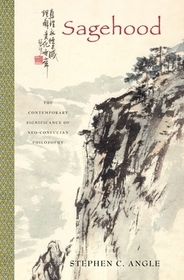
Sagehood
The Contemporary Significance of Neo-Confucian Philosophy
- Publisher's listprice GBP 47.49
-
21 441 Ft (20 420 Ft + 5% VAT)
The price is estimated because at the time of ordering we do not know what conversion rates will apply to HUF / product currency when the book arrives. In case HUF is weaker, the price increases slightly, in case HUF is stronger, the price goes lower slightly.
- Discount 10% (cc. 2 144 Ft off)
- Discounted price 19 297 Ft (18 378 Ft + 5% VAT)
Subcribe now and take benefit of a favourable price.
Subscribe
21 441 Ft

Availability
printed on demand
Why don't you give exact delivery time?
Delivery time is estimated on our previous experiences. We give estimations only, because we order from outside Hungary, and the delivery time mainly depends on how quickly the publisher supplies the book. Faster or slower deliveries both happen, but we do our best to supply as quickly as possible.
Product details:
- Publisher OUP USA
- Date of Publication 15 March 2012
- ISBN 9780199922239
- Binding Paperback
- No. of pages312 pages
- Size 234x156x16 mm
- Weight 440 g
- Language English 0
Categories
Short description:
Stephen Angle here provides both an exposition of Neo-Confucian philosophy and a sustained dialogue with many leading Western thinkers--and especially with those philosophers leading the current renewal of interest in virtue ethics.
MoreLong description:
Neo-Confucianism is the sophisticated revival of Confucian theorizing, responding to challenges from Buddhism and Daoism, which began around 1000 C.E. and came to dominate the Chinese intellectual scene for centuries thereafter. What would happen if we took Neo-Confucianism and its central ideal of sagehood seriously as contemporary philosophy? Sagehood represents supreme human virtue: a flawless, empathetic responsiveness to every situation in which one finds oneself. How could this be possible? How might one work toward such a state? According to Neo-Confucians, we should all strive to become sages, whether or not we ultimately achieve it. Taking neo-Confucianism seriously means to explore the ways that its theories of psychology, ethics, education, and politics engage with the views of contemporary philosophers. Angle's book is therefore both an exposition of Neo-Confucian philosophy and a sustained dialogue with many leading Western thinkers--and especially with those philosophers leading the current renewal of interest in virtue ethics. The book's significance is two-fold: it argues for a new stage in the development of contemporary Confucian philosophy, and it demonstrates the value to Western philosophers of engaging with the Neo-Confucian tradition.
"Rarely is a work in comparative philosophy itself an original philosophical contribution. But that is the case in this instance in which Angle brings Neo-Confucian philosophy into fruitful conversation with contemporary Western, virtue-ethics based analytic philosophers.The result is a presentation of Neo-Confucianism that advances it beyond any previous Neo-Confucian: Angle is the best in the line so far, at least among those writing or written about in English." - Robert Cummings Neville, The Review of Metaphysics
"This book does an outstanding job of engaging a wide range of sources not only from different areas of philosophy (such as virtue ethics and Chinese philosophy) but also from the disciplines of religious studies and Asian studies. Indeed, one thing that makes this book worth reading is the way it puts new and interesting sources into conversation with one another in order to shed new light on the topics at hand. While this work is certainly recommended for specialists in comparative ethics and Chinese philosophy, it is also a resource for philosophers interested in learning how non-Western philosophy might potentially contribute to work in ethics today." - Eric Cline, Mind
"Throughout the book, Angle makes good use of recent empirical studies. His book is very accessible for readers with a wide variety of backgrounds. Philosophers with no background in Chinese thought will find challenging and interesting discussions of many issues relevant to their own work. Furthermore, I think this book is also quite appropriate to assign to strong undergraduate students. I recommend it highly." - Bryan W. van Norden, Notre Dame Philosophical Reviews
Rarely is a work in comparative philosophy itself an original philosophical contribution. But that is the case in this instance in which Angle...brings Neo-Confucian philosophy into fruitful conversation with contemporary Western, virtue-ethics based analytic philosophers...The result is a presentation of Neo-Confucianism that advances it beyond any previous Neo-Confucian: Angle is the best in the line so far, at least among those writing or written about in English.
Table of Contents:
Dedication
Preface
Chronology and Dramatis Personae
PART I: KEYWORDS
1 - Sheng/Sage
1.1 "Sage" in the Confucian Tradition
1.1.1 Historical Survey
1.1.2 Neo-Confucianism
1.1.3 Shengren versus Junzi
1.2 Western Ideals
1.2.1 Greece
1.2.2 Contemporary Saints and Heroes
1.3 Concerns About Sagehood
1.3.1 Is Sagehood Realistic?
1.3.2 Is Sagehood Desirable?
2 - Li/Coherence
2.1 First Steps
2.2 Subjective and Objective
2.2.1 Nature and Subjectivity
2.2.2 Settled Coherence and Objectivity
2.3 Li and Qi
2.4 One and Many
2.5 Normativity and Creativity
3 - De/Virtue
3.1 Virtue as a Bridge Concept
3.2 Early "De"
3.3 Neo-Confucian "De"
3.4 Final Thoughts
4 - He/Harmony
4.1 Early Classical Sources
4.1.1 Complementary Differences
4.1.2 Natural Patterns and Creativity
4.2 The Zhongyong ("Doctrine of the Mean")
4.3 Song Neo-Confucianism
4.4 Wang Yangming: Summary and Initial Engagement
4.4.1 Harmony, Coherence and One Body
4.4.2 A Contemporary Example
4.4.3 Politics
PART II: ETHICS AND PSYCHOLOGY
5 - The Scope of Ethics: Dialogue with Slote and Murdoch
5.1 Balance and Harmony in Slote's Agent-Based Ethics
5.1.1 Caring, Humaneness (Ren), and Empathy
5.1.2 Two Kinds of Balance
5.1.3 The Motivation for Overall Balance
5.1.4 Agent-Basing
5.1.5 Reverence
5.2 Murdoch on the Importance of a Transcendent Good
5.2.1 Unity, Mystery, and Faith
5.2.2 Selflessness
5.3 Conclusion: The Scope of Ethics
6 - Challenging Harmony: Consistency, Conflicts, and the Status Quo
6.1 Nussbaum and Stohr Against "Harmony"
6.2 Imagination
6.3 Maximization
6.4 Residue
6.4.1 Complicating the Picture
6.4.2 Grief versus Regret
6.5 Dimensions of Dilemmas
6.6 Emotional Vanilla?
6.6.1 Myers's Challenge
6.6.2 Neo-Confucians on Anger
6.6.3 Conclusions
7 - Sagely Ease and Ethical Perception
7.1 Wang Yangming on Analects 2:4; the Centrality of "Commitment"
7.1.1 Commitment in Classical Texts
7.1.2 Commitment in Wang Yangming
7.1.3 Deepening Our Commitment
7.2 Connecting "Commitment" to "Unity of Knowledge and Action"
7.3 Cua on commitment to realizing a harmonious world
7.3.1 Active Moral Perception
7.3.2 Creativity Revisited
7.4 A Fuller Picture
7.4.1 Murdoch on M and D
7.4.2 Intrusions of the Self
7.4.3 "True Vision Occasions Right Conduct"
PART III: EDUCATION AND POLITICS
8 - Learning to Look for Harmony
8.1 Stages of Ethical Education
8.1.1 Lesser Learning
8.1.2 Establishing a Commitment
8.1.3 Matur(ing) Commitment
8.2. Practices of self-improvement
8.2.1 Spiritual Exercises
8.2.2 Ritual
8.2.3 Reading
8.2.4 Attention - First Steps
8.2.5 Reverence
8.2.6 Further Implications
8.2.7 Reverence and Coherence
8.2.8 Self-Restraint and Quiet Sitting
8.2.9 Conclusion
9 - Engaging Practices
9.1 The Nature of Commitments
9.2 Stages and the Accessibility of Sagely Ideals
9.3 Attention Revisited
9.4 Imagination and Fantasy
9.5 Dialogue
9.6 Faith and Belief
10 - The Political Problem
10.1 Introduction: The Trouble with Sagehood
10.2 Sage and Politics in Song-Qing Neo-Confucianism
10.2.1 Sage-King ideal
10.2.2 Limits and Guidance
10.2.3 Ritual
10.2.4 Institutions
10.2.5 Vaulting Ambition: Rulers Who Think They are Sages
10.3 Confucian Soft Authoritarianism
10.4 Separating the Moral from the Political?
10.4.1 Yu Yingshi and Xu Fuguan
10.4.2 Mou Zongsan
11 - Sages and Politics: A Way Forward
11.1 Perfection and Fallibility
11.2 Reverence and Ritual
11.3 Perfectionism and Institutions
11.3.1 Moderate Perfectionism
11.3.2 Confucian State Perfectionism
11.3.3 Specificity and Particularism
11.4 Participation
11.4.1 Three Arguments
11.4.2 Implications and Objections
11.5 Laws and Rights as a System of Second Resort
11.5.1 Rule by Law
11.5.2 Law and Morality
11.5.3 A Confucian Approach
Conclusion: The Future of Contemporary Confucianisms
Bibliography
Index Locorum
General Index

