

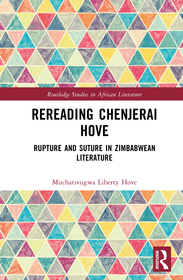
Rereading Chenjerai Hove
Rupture and Suture in Zimbabwean Literature
Series: Routledge Studies in African Literature;
- Publisher's listprice GBP 155.00
-
69 982 Ft (66 650 Ft + 5% VAT)
The price is estimated because at the time of ordering we do not know what conversion rates will apply to HUF / product currency when the book arrives. In case HUF is weaker, the price increases slightly, in case HUF is stronger, the price goes lower slightly.
- Discount 20% (cc. 13 996 Ft off)
- Discounted price 55 986 Ft (53 320 Ft + 5% VAT)
- Discount is valid until: 30 June 2026
Subcribe now and take benefit of a favourable price.
Subscribe
62 984 Ft

Availability
Estimated delivery time: In stock at the publisher, but not at Prospero's office. Delivery time approx. 3-5 weeks.
Not in stock at Prospero.
Why don't you give exact delivery time?
Delivery time is estimated on our previous experiences. We give estimations only, because we order from outside Hungary, and the delivery time mainly depends on how quickly the publisher supplies the book. Faster or slower deliveries both happen, but we do our best to supply as quickly as possible.
Product details:
- Edition number 1
- Publisher Routledge
- Date of Publication 8 April 2026
- ISBN 9781041239918
- Binding Hardback
- No. of pages204 pages
- Size 234x156 mm
- Weight 540 g
- Language English
- Illustrations 2 Tables, black & white 694
Categories
Short description:
This book assesses the life and works of leading Zimbabwean poet and novelist, Chenjerai Hove. Proposing a reading of Hove’s work through the dual concepts of rupture and suture, this book investigates Hove’s position as a writer in exile.
MoreLong description:
This book assesses the life and works of the leading Zimbabwean poet and novelist, Chenjerai Hove. Proposing a reading of Hove’s work through the dual concepts of rupture and suture, this book investigates Hove’s position as a writer at home and in exile.
Described affectionately as ‘Change’ by his contemporaries, Hove’s longing and desire for a free Zimbabwe runs through his works both in his first language, ChiShona, and in his second language, English. Whilst nationalist struggles promised a sense of suture from the wounds of colonialism, in the postcolonial period a new political elite introduced new ruptures, looting resources and flouting the rule of law. Hove’s narratives of decolonisation, globalisation and indigenous becoming in his works point to these unfinished historical processes of rupture and suture, bringing in contrasting themes of beauty and ugliness, democracy and despotism, development and anarchy, independence and corruption. In deploying a framework of rupture and suture to Hove’s work, this book disrupts fundamentalist frameworks suggesting a return to a pristine precolonial past and argues instead that the process of decolonising is relational and reflexive. Providing an important original analysis of Hove’s work, this book also brings in comparisons with other writers in exile, arguing that displaced citizenship allows African writers to trouble the disjuncture/s in the nationalist and postcolonial project.
As such, this book will be an important read not only for researchers of Zimbabwean literature but also for scholars working on African and diasporic literature more widely.
MoreTable of Contents:
1. Setting and unsettling the cultural context 2. Continuities and disruptions in Chenjerai Hove’s poetry 3. Culture, nation and critique in Chenjerai Hove’s essays 4. Imagining and re-inventing the nation through the novel and auto/biography 5. Futuring a southern episteme; Curating struggle and memory 6. Connecting narrative/s as voicing cultural and epistemic freedoms
More
