

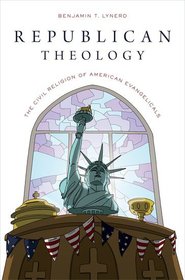
Republican Theology
The Civil Religion of American Evangelicals
- Publisher's listprice GBP 147.50
-
66 596 Ft (63 425 Ft + 5% VAT)
The price is estimated because at the time of ordering we do not know what conversion rates will apply to HUF / product currency when the book arrives. In case HUF is weaker, the price increases slightly, in case HUF is stronger, the price goes lower slightly.
- Discount 10% (cc. 6 660 Ft off)
- Discounted price 59 937 Ft (57 083 Ft + 5% VAT)
Subcribe now and take benefit of a favourable price.
Subscribe
66 596 Ft

Availability
printed on demand
Why don't you give exact delivery time?
Delivery time is estimated on our previous experiences. We give estimations only, because we order from outside Hungary, and the delivery time mainly depends on how quickly the publisher supplies the book. Faster or slower deliveries both happen, but we do our best to supply as quickly as possible.
Product details:
- Publisher OUP USA
- Date of Publication 25 September 2014
- ISBN 9780199363551
- Binding Hardback
- No. of pages264 pages
- Size 160x239x20 mm
- Weight 567 g
- Language English 0
Categories
Short description:
Since the founding, American evangelicals have espoused a civil religion that sees limited government as a condition for a thriving church. This "republican theology," however, also accentuates the church's capacity to elevate civic virtue.
MoreLong description:
As an electoral bloc, contemporary white evangelical Christians maintain a remarkable ideological and partisan conformity, perhaps unmatched by any other community outside of African Americans. Historically, evangelicals have supported various political parties, but their approach to civil religion, or the way that they apply the spiritual to the public realm, has, as Republican Theology argues, been consistent in its substance since the founding of the nation. Put simply, this civil religion holds that limited government and a free-market are essential to the cultivation of Christian virtue, while the livelihood of the republic depends on the virtue of its citizens. While evangelicals have long promoted conservative moral causes, from temperance and anti-obscenity in the nineteenth century to abstinence education in the twentieth, they have also aligned themselves on many other seemingly unrelated agendas: in support of the Revolution in the 1770s, on antislavery in the 1820s, against labor unionism in the 1880s, against the New Deal in the 1930s, on assertive anticommunism in the 1950s (a major theme in Billy Graham's early sermons), and in favor of deregulation and lower taxes in the 1980s.
As Benjamin T. Lynerd contends, the rise of the "New Right " movement at the end of the twentieth century had as much to do with small-government ideology as with a recovery of traditional morality. This libertarian ethos combined with restrictive public moralism is conflicted, and it creates friction both within the New Right alliance and within the church, particularly among evangelicals interested in social justice. Still, it has formed the entire subtext of evangelical participation in American politics from the 1770s into the twenty-first century. Lynerd looks at the evolution of evangelical civil religion, or "republican theology " to demonstrate how evangelicals navigate this logic.
This timely book makes a solid historical contribution by documenting a long, reasonably flexible, yet still very coherent tradition of American 'republican theology.' Yet the book goes beyond history to also offer an unusually perceptive analysis of where 'republican theology' has functioned for the good of the nation-and for the Christian faith-and where it has not. This major book should have a major impact.
Table of Contents:
Introduction
Chapter 1: Evangelicals as Lockeans
Chapter 2: Republican Theology
Chapter 3: Covenantal Origins
Chapter 4: American Foundations
Chapter 5: Entrenchment in the Second Great Awakening
Chapter 6: Darwin as Ally, Social Gospel as Foe
Chapter 7: The Triumph of Free Market Theology
Epilogue
Notes
Index

