

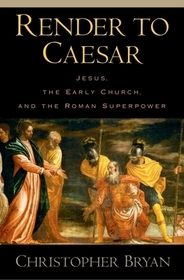
Render to Caesar
Jesus, the Early Church, and the Roman Superpower
- Publisher's listprice GBP 51.00
-
23 026 Ft (21 930 Ft + 5% VAT)
The price is estimated because at the time of ordering we do not know what conversion rates will apply to HUF / product currency when the book arrives. In case HUF is weaker, the price increases slightly, in case HUF is stronger, the price goes lower slightly.
- Discount 10% (cc. 2 302 Ft off)
- Discounted price 20 724 Ft (19 737 Ft + 5% VAT)
Subcribe now and take benefit of a favourable price.
Subscribe
23 026 Ft

Availability
printed on demand
Why don't you give exact delivery time?
Delivery time is estimated on our previous experiences. We give estimations only, because we order from outside Hungary, and the delivery time mainly depends on how quickly the publisher supplies the book. Faster or slower deliveries both happen, but we do our best to supply as quickly as possible.
Product details:
- Publisher OUP USA
- Date of Publication 29 September 2005
- ISBN 9780195183344
- Binding Hardback
- No. of pages200 pages
- Size 163x236x22 mm
- Weight 448 g
- Language English 0
Categories
Short description:
In this book, Christopher Bryan reexamines the attitude of the early Church toward imperial Rome. Choosing a middle road, he says that Jesus and the early Christians did indeed have a critique of the Roman superpower - a critique that was broadly in line with the entire biblical and prophetic tradition. One cannot worship the biblical God, the God of Israel, he says, and not be concerned about justice, including international justice, here and now. On the other hand, Bryan does not think that the biblical tradition challenges human power structures by attempting to dismantle them or replace them with other power structures. Instead, he says, it consistently confronts such structures with the truth about their origin and purpose. Their origin is that God permits them. Their purpose is to serve God's glory by promoting God's peace and God's justice. As Bryanu puts it, "the prophetic tradition subverts 'the powers that be' by persistently demanding that they do their job."
MoreLong description:
In this book, Christopher Bryan reexamines the attitude of the early Church toward imperial Rome. Choosing a middle road, he says that Jesus and the early Christians did indeed have a critique of the Roman superpower - a critique that was broadly in line with the entire biblical and prophetic tradition. One cannot worship the biblical God, the God of Israel, he says, and not be concerned about justice, including international justice, here and now. On the other hand, Bryan does not think that the biblical tradition challenges human power structures by attempting to dismantle them or replace them with other power structures. Instead, he says, it consistently confronts such structures with the truth about their origin and purpose. Their origin is that God permits them. Their purpose is to serve God's glory by promoting God's peace and God's justice. As Bryanu puts it, "the prophetic tradition subverts 'the powers that be' by persistently demanding that they do their job."
...the epitome of balanced scholarship ... Bryan is to be commended for the clear and concise way in which he presents his argument. This is an eminently readable book.

