

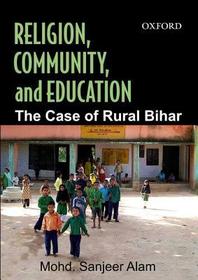
Religion, Community, and Education.
The Case of Rural Bihar
- Publisher's listprice GBP 26.99
-
12 185 Ft (11 605 Ft + 5% VAT)
The price is estimated because at the time of ordering we do not know what conversion rates will apply to HUF / product currency when the book arrives. In case HUF is weaker, the price increases slightly, in case HUF is stronger, the price goes lower slightly.
- Discount 10% (cc. 1 219 Ft off)
- Discounted price 10 967 Ft (10 445 Ft + 5% VAT)
Subcribe now and take benefit of a favourable price.
Subscribe
12 185 Ft

Availability
Only to order.
Why don't you give exact delivery time?
Delivery time is estimated on our previous experiences. We give estimations only, because we order from outside Hungary, and the delivery time mainly depends on how quickly the publisher supplies the book. Faster or slower deliveries both happen, but we do our best to supply as quickly as possible.
Product details:
- Publisher OUP India
- Date of Publication 26 January 2012
- ISBN 9780198076940
- Binding Hardback
- No. of pages258 pages
- Size 222x146x18 mm
- Weight 414 g
- Language English 0
Categories
Short description:
This book assesses literacy and educational levels among Hindus and Muslims in rural Bihar as well as the disparity therein. It is based on extensive fieldwork conducted in the state, covering 300 households and 700 schoolchildren. It also draws upon empirical data from the Census and NSSO.
MoreLong description:
In recent times, religion-based educational disparities in India, especially between Hindus and Muslims, have been the focus of passionate debate. Yet, there is considerable gap in understanding the dynamics of religion and propensity to education. This book assesses literacy and educational levels among Hindus and Muslims in rural Bihar as well as the disparity therein.
The author uses a distinctive conceptual and analytical framework to examine educational disparities in schooling between these religious communities in particular. In doing so, he applies spatially embedded historical trajectories to examine their educational development. It is argued that religious communities have to be seen as spatially embedded rather than as homogeneous socio-cultural aggregates, for spatial locatedness reflects varying and complicated patterns of socio-economic and educational outcomes. The study is based on extensive fieldwork conducted in rural Bihar, covering 300 households and 700 schoolchildren. It also draws upon empirical data from the Census and NSSO.
Table of Contents:
List of Tables and Figures
Foreword
Preface
Acknowledgements
PART I: Introduction;
Iniquities in Education in India: Genesis and Dimensions;
Religion and Educational Inequality: Past and Present;
Religion and Education: Theoretical Foundations;
PART II:
Understanding the Context: Structures and Processes;
Religion and Educational Attainment: A Micro View;
Unpacking the Dynamics of Inequality in Education; Summary and Conclusion
Appendices
Bibliography
Index

