

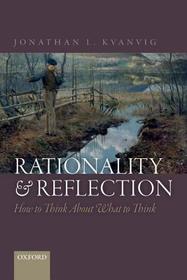
Rationality and Reflection
How to Think About What to Think
- Publisher's listprice GBP 27.99
-
12 637 Ft (12 035 Ft + 5% VAT)
The price is estimated because at the time of ordering we do not know what conversion rates will apply to HUF / product currency when the book arrives. In case HUF is weaker, the price increases slightly, in case HUF is stronger, the price goes lower slightly.
- Discount 10% (cc. 1 264 Ft off)
- Discounted price 11 373 Ft (10 832 Ft + 5% VAT)
Subcribe now and take benefit of a favourable price.
Subscribe
12 637 Ft

Availability
printed on demand
Why don't you give exact delivery time?
Delivery time is estimated on our previous experiences. We give estimations only, because we order from outside Hungary, and the delivery time mainly depends on how quickly the publisher supplies the book. Faster or slower deliveries both happen, but we do our best to supply as quickly as possible.
Product details:
- Publisher OUP Oxford
- Date of Publication 26 January 2017
- ISBN 9780198797197
- Binding Paperback
- No. of pages206 pages
- Size 231x156x11 mm
- Weight 322 g
- Language English 0
Categories
Short description:
Jonathan L. Kvanvig presents a new account of rationality, Perspectivalism, which both avoids elevating rationality so that only the most reflective of us are capable of rational beliefs, and avoids reducing it to the level of beasts. He defends optionality about what it is reasonable to think, and provides a framework for rational disagreement.
MoreLong description:
Jonathan L. Kvanvig presents a conception of rationality which answers to the need arising out of the egocentric predicament concerning what to do and what to believe. He does so in a way that avoids, on the one hand, reducing rationality to the level of beasts, and on the other hand, elevating it so that only the most reflective among us are capable of rational beliefs. Rationality and Reflection sets out a theory of rationality--a theory about how to determine what to think--which defends a significant degree of optionality in the story of what is reasonable for people to think, and thereby provides a framework for explaining what kinds of rational disagreement are possible. The theory is labelled Perspectivalism and it offers a unique account of rationality, one that cuts across the usual distinctions between Foundationalism and Coherentism and between Internalism and Externalism. It also differs significantly from Evidentialism, maintaining that, to the extent that rationality is connected to the notion of evidence, it is a function both of the evidence one has and what one makes of it.
Recommended. Upper-division undergraduates through researchers/faculty.
Table of Contents:
Introduction
Epistemic Appraisal
The Egocentric Predicament and Normativity
Excusability
Rational Disagreement
Perspectivalism and Optionalism
From Schema to Theory: The Role of Autonomy in the Theory of Rationality
Conclusion
Reducing Personal to Doxastic Justification
Reducing Doxastic to Propositional Justification
Index
Bibliography

