

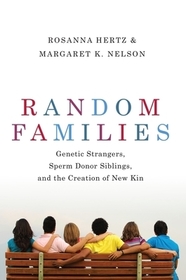
Random Families
Genetic Strangers, Sperm Donor Siblings, and the Creation of New Kin
- Publisher's listprice GBP 18.99
-
8 573 Ft (8 165 Ft + 5% VAT)
The price is estimated because at the time of ordering we do not know what conversion rates will apply to HUF / product currency when the book arrives. In case HUF is weaker, the price increases slightly, in case HUF is stronger, the price goes lower slightly.
- Discount 20% (cc. 1 715 Ft off)
- Discounted price 6 859 Ft (6 532 Ft + 5% VAT)
- Discount is valid until: 30 June 2026
Subcribe now and take benefit of a favourable price.
Subscribe
8 573 Ft

Availability
Estimated delivery time: In stock at the publisher, but not at Prospero's office. Delivery time approx. 3-5 weeks.
Not in stock at Prospero.
Why don't you give exact delivery time?
Delivery time is estimated on our previous experiences. We give estimations only, because we order from outside Hungary, and the delivery time mainly depends on how quickly the publisher supplies the book. Faster or slower deliveries both happen, but we do our best to supply as quickly as possible.
Product details:
- Publisher OUP USA
- Date of Publication 8 September 2020
- ISBN 9780197519981
- Binding Paperback
- No. of pages312 pages
- Size 234x155x20 mm
- Weight 454 g
- Language English
- Illustrations 1 line drawing ; 6 halftones 36
Categories
Short description:
The ready availability of donated sperm and eggs has made possible an entirely new form of family. Children of the same donor and their families, with the help of social media and the internet, can now locate each other and make contact. Based on over 350 interviews with children and parents, Rosanna Hertz and Margaret K. Nelson share how these remarkable relationships woven from tenuous bits of information and fueled by intense curiosity are expanding the possibilities for kinship. Random Families is a highly readable account of life at the intersection of reproductive technology, social media, and the human desire for intimacy and identity.
MoreLong description:
Random Families is about the unprecedented families that have grown up at the intersection of new reproductive technologies, social media, and the human desire for belonging. Children of the same donor and their families, with the help of the internet, can now locate each other and make contact. Based on over 350 interviews with children (ages 10-28), their parents and related donors from all over the U.S., Random Families chronicles the chain of choices that couples and single mothers make from what donor to use to how to participate (or not) in donor sibling networks. Children reveal their understanding of a donor, the donor's spot on the family tree and the meaning of their donor siblings. Through rich first-person accounts of network membership, the book illustrates how these extraordinary relationships-woven from bits of online information and shared genetic ties-are transformed into new possibilities for kinship. Random Families offers down-to-earth stories from real families to highlight just how truly distinctive these contemporary new forms of family are.
The scope of Random Families is astounding...Hertz and Nelson have made a significant contribution to what is an area of research in its infancy and have sparked an important conversation on what it means to be a family.
Table of Contents:
Introduction: Unprecedented Relationships
Part I: Making Sense of the Donor and Donor Siblings
Chapter 1. Choosing Donors
Chapter 2. Inventing the Donor / Inventing the Self
Chapter 3. Parents Make Contact with Genetic Strangers
Chapter 4. The Surprise of donor siblings
Part II: Networks of Donor Siblings
Chapter 5. Michael's Clan: The Arrival of the Father
Chapter 6. 7008 Builders: We are Family
Chapter 7. The Tourists: Just Related Strangers
Chapter 8. Connected Soul Mates: Emotional Ties
Chapter 9. The Social Capitalists: Joining The Preschoolers Group
Chapter 10. Donor Sibling Networks: Continuity and Change
Conclusion: Choice in Donor Sibling Networks
Appendix A: Respondents
Appendix B: Interviews, Virtual Ethnography And Language In The Book
Endnotes
Bibliography

