

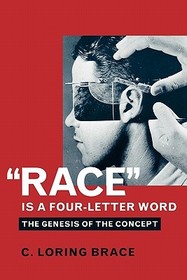
'Race' Is a Four-Letter Word
The Genesis of the Concept
- Publisher's listprice GBP 37.99
-
17 152 Ft (16 335 Ft + 5% VAT)
The price is estimated because at the time of ordering we do not know what conversion rates will apply to HUF / product currency when the book arrives. In case HUF is weaker, the price increases slightly, in case HUF is stronger, the price goes lower slightly.
- Discount 10% (cc. 1 715 Ft off)
- Discounted price 15 437 Ft (14 702 Ft + 5% VAT)
Subcribe now and take benefit of a favourable price.
Subscribe
17 152 Ft

Availability
Uncertain availability. Please turn to our customer service.
Why don't you give exact delivery time?
Delivery time is estimated on our previous experiences. We give estimations only, because we order from outside Hungary, and the delivery time mainly depends on how quickly the publisher supplies the book. Faster or slower deliveries both happen, but we do our best to supply as quickly as possible.
Product details:
- Publisher OUP USA
- Date of Publication 3 March 2005
- ISBN 9780195173512
- Binding Paperback
- No. of pages336 pages
- Size 234x155x16 mm
- Weight 475 g
- Language English
- Illustrations 6 maps, numerous halftones and line illustrations 0
Categories
Short description:
This text is designed to be used as a supplementary text for any course in which the instructor wants to explore the history of the concept of race in America, the reasons why the concept has no biological validity, and how "race" grew to become accepted as something that virtually everyone regards as self-evident. The first chapter lays out the reasons why the concept is biologically indefensible, and the remainder of the book examines the course of events that
created that concept; the journey through time goes from Herodotus through Marco Polo, the Renaissance and the role of the New World, on up to the American Civil War, the curious results of the alliance switch in World War I, Arthur Jensen, the Bell Curve, J. Phillippe Rushton, and the Pioneer Fund in
the 21st century.
Long description:
This text is designed to be used as a supplementary text for any course in which the instructor wants to explore the history of the concept of race in America, the reasons why the concept has no biological validity, and how "race" grew to become accepted as something that virtually everyone regards as self-evident. The first chapter lays out the reasons why the concept is biologically indefensible, and the remainder of the book examines the course of events that
created that concept; the journey through time goes from Herodotus through Marco Polo, the Renaissance and the role of the New World, on up to the American Civil War, the curious results of the alliance switch in World War I, Arthur Jensen, the Bell Curve, J. Phillippe Rushton, and the Pioneer Fund in
the 21st century.
Table of Contents:
Preface
Introduction
1. The Biology of Human Variation
Background of a Belief
Adaptive Traits: Clines
Skin
Tooth Size
Hemoglobin S
Blood Groups
Clusters and Non-Adaptive Traits
2. The Perception and Human Differences in the Past
What Should We Call "Them?"
The Peasant Perspective
Antiquity
Renaissance
Enlightenment-The "Age of Reason"
Science and The Greatness of God
The Limits of Reason
Linnaeus and Classification
Linnaeus and the Classification of the Human Species
The Great Chain of Being
Buffon and Continuity
Camper and the Facial Angle
Assessing the Meaning of Human Differences
3. One Origin or Many?
The Roots of "Polygenism"
Paracelsus
Peyrere
Monogenism
4. Anthropology in the Enlightenment
Blumenbach and "Degeneration"
The Scottish Enlightenment Comes to America
Samuel Stanhope Smith: "Race" From the Perspective of the American Enlightenment
5. The Triumph of Feeling Over Reason
Romanticism
6. Phrenology
7. The Founding of the American School of Anthropology
The Post-Colonial United States of America
Samuel George Morton and the American Origin of Biological Anthropology
8. Passing the Torch
Louis Agassiz, Archetypical American
9. The Demise of Monogenism and the Rise of Polygenism
John Bachman: The Last Monogenist
Josiah Clark Nott: The Voice of American Radicalism
Scotland: Dr. Robert Knox
France: Comte de Gobineau
10. Towards a War Over Slavery and Afterwards
George R. Gliddon
"Race" and Politics
War and Its Aftermath
11. The French Connection
Paul Broca and the Professionalization of Biological Anthropology
The Demise of the American School of Anthropology
12. The Legacy of the American School in America
Nathaniel Southgate Shaler (1841-1906)
The First World War
The French Connection and the Concept of "Race"
William Z. Ripley and the Magic Three
Madison Grant
Lothrop Stoddard
13. The Ethos of Eugenics
Eugenics
Eugenics Exported to America
Germany
"Race" and Eugenics Applied to the Shaping of America
14. Henry Ford and the Ethos of the Holocaust
The Anti-Semitism of Henry Ford
The Protocols of the Elders of Zion
15. The Outlook of the Bigot Brigade
"Race" and "Intelligence"
"Statistical Theology and the Worship of 'g'"
Sir Cyril Burt-"Scientific" Fraud
16. The Galtonian Legacy in America
World War I
"Intelligence" and Immigration
Lewis Terman and Genetic Predestination
Walter Lippmann Versus the Termanites
17. "Race" in Biological Anthropology
Ale Hrdlicka and the Smithsonian: Organizing the Profession
Academia and The Patterns of Thought in Biological Anthropology: Sir Arthur Keith
Keith's Influence on America: Earnest Albert Hooton
Carleton Coon on "Race"
Science and Society on "Race" After World War II
18. The Legacy of Pioneer Fund
The Promotion of "Scientific" Racism
Jensenism
Galton and "The Bell Curve"
J. Philippe Rushton
Richard Lynn
19. "Otherism"
Afterthoughts
Sources Cited
Index

