

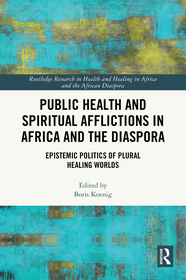
Public Health and Spiritual Afflictions in Africa and the Diaspora
Epistemic Politics of Plural Healing Worlds
Series: Routledge Research in Health and Healing in Africa and the African Diaspora;
- Publisher's listprice GBP 155.00
-
69 982 Ft (66 650 Ft + 5% VAT)
The price is estimated because at the time of ordering we do not know what conversion rates will apply to HUF / product currency when the book arrives. In case HUF is weaker, the price increases slightly, in case HUF is stronger, the price goes lower slightly.
- Discount 20% (cc. 13 996 Ft off)
- Discounted price 55 986 Ft (53 320 Ft + 5% VAT)
- Discount is valid until: 30 June 2026
Subcribe now and take benefit of a favourable price.
Subscribe
62 984 Ft

Availability
Not yet published.
Why don't you give exact delivery time?
Delivery time is estimated on our previous experiences. We give estimations only, because we order from outside Hungary, and the delivery time mainly depends on how quickly the publisher supplies the book. Faster or slower deliveries both happen, but we do our best to supply as quickly as possible.
Product details:
- Edition number 1
- Publisher Routledge
- Date of Publication 30 June 2026
- ISBN 9781041032281
- Binding Hardback
- No. of pages246 pages
- Size 234x156 mm
- Weight 453 g
- Language English
- Illustrations 10 Illustrations, black & white; 10 Halftones, black & white 700
Categories
Short description:
This book examines the paradox whereby spiritual afflictions remain central in Africa and the diaspora, yet are routinely sidelined in official public health policies and global health agendas. It speaks to scholars and students in anthropology, political science, and public health, as well as clinicians, policymakers and practitioners.
MoreLong description:
This book examines the paradox whereby spiritual afflictions (conditions attributed to ancestors, jinns, spirits, witchcraft, and other intangible entities) remain central to everyday therapeutic worlds in Africa and the diaspora, yet are routinely sidelined or rendered invisible in official public health policies and global health agendas.
Drawing on ethnographic research in Cameroon, Congo, Côte d’Ivoire, Ghana, Mozambique, South Africa, Tanzania, Zanzibar, and African diasporic communities in Europe, the book’s contributors analyse how people navigate intertwined therapeutic worlds in which invisible forces and biomedical logics coexist, collide, or bypass one another. It conceptualizes public health as a domain of ongoing epistemic struggle, examining how policies, legislation, and clinical encounters enact limited recognition and integration that keep spiritual healing subordinate even when they claim to include it. At the same time, the chapters illuminate vernacular governance, popular epistemologies, and informal infrastructures of care through which communities negotiate forms of accountability, regulate healers, and sustain therapeutic legitimacy beyond the clinic and the state. Ethnography is positioned here as an epistemic infrastructure in its own right, capable of unsettling dominant assumptions and opening space for more equitable, plural public health futures.
The book speaks to scholars and students in anthropology, political science, and public health, as well as clinicians, policymakers, and practitioners in global health and development. It offers conceptual and methodological tools for rethinking what counts as evidence, legitimate care, and public health expertise, inviting readers to imagine health institutions that are attentive to plural epistemologies and responsive to the lived realities of those navigating diverse therapeutic worlds.
"Public Health and Spiritual Afflictions in Africa and the Diaspora provides a nuanced look into the complex relationships between public health and a wide range of spiritual healing practices from across sub-Saharan Africa and its diaspora. Never content to accept simple appeals to inclusion or collaboration at face value, the authors draw on detailed ethnographic cases to explore how epistemic legitimacy is produced and negotiated within and beyond institutional boundaries."
China Scherz, Professor of Global Affairs, Keough School of Global Affairs, University of Notre Dame, USA.
"A fascinating and profound set of cases written by a marvelous combination of starstudded and emerging scholars, Public Health and Spiritual Afflictions in Africa and the Diaspora reveals links of co-creation among belonging, exclusion, and public health structures in conditions of medical pluralism. Taking the social dynamics of spiritual insecurity seriously, it proposes new means to address epistemic dialogue among states, healers, patients, and kin, aiming to improve African and African-diasporic experiences of health and care by reshaping global health’s epistemic foundations."
Pamela Feldman-Savelsberg, Broom Professor of Anthropology and Social Demography, Carleton College, USA.
MoreTable of Contents:
Introduction: Reimagining Public Health’s Epistemic Infrastructures from the Lived Realities of Spiritual Healing 1. Affliction, Healing, and Everyday Religion: Perceptions of Well-Being, Ill Health, and its Remedy in Zanzibar 2. The Payment of Spiritual Debts as Restitution Among the Babanki of Northwest Cameroon 3. Kindoki, Institutional Legitimacy, and Public Health in the Lower Congo 4. Entrepreneurs of Grievances and Entertainment: Negotiating Social Contention and Healing in Mozambique 5. “Walking the Road to Death”: Perspectives on Cancer Causation and Interventions Among West African Immigrants in France 6. Spiritual Afflictions and Disagreements: Unpacking ‘Collaboration’ Between Community Psychiatry and Spiritual Healing in Rural Southwestern Ghana 7. Navigating Medical Pluralism: HIV/AIDS and Traditional Healing Practices in South Africa 8. Nganga and Public Health: How to Deal with the Ambiguities of Healing? 9. “Waganga Use Culture, Not Science”: Traditional Healing, COVID-19, and Epistemic Contestation in Tanzania 10. Debilitating Afflictions, Christian and Islamic Healing Centers, and the Reshaping of Public Health in Côte d’Ivoire Epilogue
More
