

- Publisher's listprice GBP 9.99
-
4 510 Ft (4 295 Ft + 5% VAT)
The price is estimated because at the time of ordering we do not know what conversion rates will apply to HUF / product currency when the book arrives. In case HUF is weaker, the price increases slightly, in case HUF is stronger, the price goes lower slightly.
- Discount 20% (cc. 902 Ft off)
- Discounted price 3 608 Ft (3 436 Ft + 5% VAT)
- Discount is valid until: 30 June 2026
Subcribe now and take benefit of a favourable price.
Subscribe
4 510 Ft

Availability
Estimated delivery time: In stock at the publisher, but not at Prospero's office. Delivery time approx. 3-5 weeks.
Not in stock at Prospero.
Why don't you give exact delivery time?
Delivery time is estimated on our previous experiences. We give estimations only, because we order from outside Hungary, and the delivery time mainly depends on how quickly the publisher supplies the book. Faster or slower deliveries both happen, but we do our best to supply as quickly as possible.
Product details:
- Publisher OUP Oxford
- Date of Publication 28 July 2016
- ISBN 9780199688463
- Binding Paperback
- No. of pages160 pages
- Size 174x115x9 mm
- Weight 126 g
- Language English
- Illustrations 10 black and white images 120
Categories
Short description:
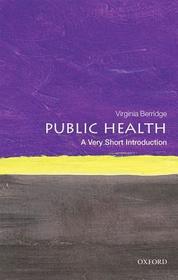
This Very Short Introduction outlines the nature of public health in our world today and places public health in its historical context from the earliest times, analysing in particular the changes in public health regulation through the nineteenth century and the twentieth and twenty first centuries.
MoreLong description:
Public health is a term much used in the media, by health professionals, and by activists. At the national or the local level there are ministries or departments of public health, whilst international agencies such as the World Health Organisation promote public health policies, and regional organisations such as the European Union have public health funding and policies. But what do we mean when we speak about 'public health'?
In this Very Short Introduction Virginia Berridge explores the areas which fall under the remit of public health, and explains how the individual histories of different countries have come to cause great differences in the perception of the role and responsibilities of public health organisations. Thus, in the United States litigation on public health issues is common, but state involvement is less, while some Scandinavian countries have a tradition of state involvement or even state ownership of industries such as alcohol in connection with public health. In its narrowest sense, public health can refer to the health of a population, the longevity of individual members, and their freedom from disease, but it can also be anticipatory, geared to the prevention of illness, rather than simply the provision of care and treatment. In the way public health deals with healthy as well as sick people it is therefore a separate concept from health services, which deal with the sick population. Drawing on a wide range of international examples, Berridge demonstrates the central role of history to understanding the amorphous nature of public health today.
ABOUT THE SERIES: The Very Short Introductions series from Oxford University Press contains hundreds of titles in almost every subject area. These pocket-sized books are the perfect way to get ahead in a new subject quickly. Our expert authors combine facts, analysis, perspective, new ideas, and enthusiasm to make interesting and challenging topics highly readable.
This is an easy but thought-provoking read for anyone wishing to understand the scope and origins of public or global health policy. It is well referenced with suggestions for further reading.
Table of Contents:
What is public health?
Current challenges
The origins of public health into the 1700s
Sanitation to education 1800-1900s
The rise of lifestyle 1900-1980s
Tropical and international public health
Present and future in the light of history
References
Further Reading

