

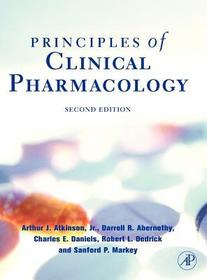
Principles of Clinical Pharmacology
Techniques, Models and Tools for 4G
- Publisher's listprice EUR 92.95
-
38 551 Ft (36 715 Ft + 5% VAT)
The price is estimated because at the time of ordering we do not know what conversion rates will apply to HUF / product currency when the book arrives. In case HUF is weaker, the price increases slightly, in case HUF is stronger, the price goes lower slightly.
- Discount 10% (cc. 3 855 Ft off)
- Discounted price 34 696 Ft (33 044 Ft + 5% VAT)
Subcribe now and take benefit of a favourable price.
Subscribe
38 551 Ft

Availability
Out of print
Why don't you give exact delivery time?
Delivery time is estimated on our previous experiences. We give estimations only, because we order from outside Hungary, and the delivery time mainly depends on how quickly the publisher supplies the book. Faster or slower deliveries both happen, but we do our best to supply as quickly as possible.
Product details:
- Edition number 2
- Publisher Elsevier Science
- Date of Publication 19 October 2006
- ISBN 9780123694171
- Binding Hardback
- No. of pages568 pages
- Size 279x215 mm
- Weight 1560 g
- Language English 0
Categories
Long description:
This revised second edition covers the pharmacologic principles underlying the individualization of patient therapy and contemporary drug development, focusing on the fundamentals that underlie the clinical use and contemporary development of pharmaceuticals. Authors drawn from academia, the pharmaceutical industry and government agencies cover the spectrum of material, including pharmacokinetic practice questions, covered by the basic science section of the certifying examination offered by the American Board of Clinical Pharmacology. This unique reference is recommended by the Board as a study text and includes modules on drug discovery and development to assist students as well as practicing pharmacologists.
MoreTable of Contents:
1. Introduction
PART 1: PHARMACOKINETICS
2. Clinical pharmacokinetics
3. Compartmental analysis of drug distribution
4. Drug absorption and bioavailability
5. Effects of renal disease on pharmacokinetics
6. Kinetics of hemodialysis and hemofiltration
7. Effects of liver disease on pharmacokinetics
8. Noncompartmental vs. compartmental approaches to pharmacokinetic analysis
9. Distributed models of drug kinetics
10. Population pharmacokinetics
PART 2: DRUG METABOLISM AND TRANSPORT
11. Pathways of drug metabolism
12. Biochemical mechanisms of drug toxicity
13. Chemical assay of drugs and drug metabolites
14. Equilibrative and concentrative transport
15. Pharmacogenetics
16. Drug interactions
PART 3: ASSESSMENT OF DRUG EFFECTS
17. Physiological and laboratory markers of drug effect
18. Dose response and concentration response analysis
19. Kinetics of pharmacologic effect
20. Disease progression models
PART 4: OPTIMIZING AND EVALUATING PATIENT THERAPY
21. Sex differences in pharmacokinetics and pharmacodynamics
22. Drug therapy in pregnant and nursing women
23. Drug therapy in neonates and pediatric patients
24. Drug therapy in the elderly
25. Clinical analysis of adverse drug reactions
26. Quality assessment of drug therapy
PART 5: DRUG DISCOVERY AND DEVELOPMENT
27. Project management
28. Drug discovery
29. Pre-clinical development
30. Animal scale up
31. Phase I studies
32. PK and PD considerations in the development of biotechnology products and large molecules
33. Design of clinical development programs
34. Good design practices for clinical trials
35. Role of the FDA in guiding drug development
Appendix
I. Table of Laplace Transforms
II. Answers to Study Problems

