

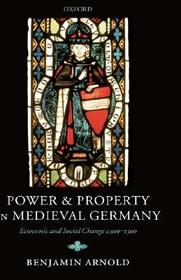
Power and Property in Medieval Germany
Economic and Social Change c.900-1300
- Publisher's listprice GBP 195.00
-
88 042 Ft (83 850 Ft + 5% VAT)
The price is estimated because at the time of ordering we do not know what conversion rates will apply to HUF / product currency when the book arrives. In case HUF is weaker, the price increases slightly, in case HUF is stronger, the price goes lower slightly.
- Discount 15% (cc. 0 Ft off)
- Discounted price 74 836 Ft (71 273 Ft + 5% VAT)
- Discount is valid until: 5 August 2026
Subcribe now and take benefit of a favourable price.
Subscribe
88 042 Ft

Availability
printed on demand
Why don't you give exact delivery time?
Delivery time is estimated on our previous experiences. We give estimations only, because we order from outside Hungary, and the delivery time mainly depends on how quickly the publisher supplies the book. Faster or slower deliveries both happen, but we do our best to supply as quickly as possible.
Product details:
- Publisher OUP Oxford
- Date of Publication 30 September 2004
- ISBN 9780199272211
- Binding Hardback
- No. of pages240 pages
- Size 224x145x17 mm
- Weight 389 g
- Language English 0
Categories
Short description:
In Power and Property in Medieval Germany Professor Arnold takes a fresh look at the problems posed by power and property in a medieval society, in this case the German kingdom. In a series of interrelated studies, Arnold explains the ongoing social and economic relationships between classes and institutions, peasants and lords, the royal court, towns and townsfolk, and the Church and aristocracy.
MoreLong description:
In Power and Property in Medieval Germany Professor Arnold takes a fresh look at the problems posed by power and property in a medieval society, in this case the German kingdom. In a series of interrelated studies covering the period 700-1500, but concentrating on the tenth to thirteenth centuries, Arnold explores the social and economic changes that influenced the real lives of people living in Germany.
A number of themes are examined, including the kind of society that emerged along the Rhine and to the east of it in a period when it is hard to identify a Germany; the complex relationship between peasant and lord; the finances and resources of the German crown, the largest single landowner; the social and economic impact of the urban milieu with its towns large and small; and the entanglement of Church and aristocracy.
Whilst medieval people did not share mercantilist or post-Adam Smith concepts of economic forces at work in society, Arnold fruitfully applies the ideas and rationalizations of modern economics to medieval evidence, leading, at times, to unexpected conclusions.
Benjamin Arnold is the leading English-speaking authority on the history of medieval Germany.
Table of Contents:
Introduction
The German Lands 700-1100
Peasants, Lords, and their Resources
The German Crown and its Assets
The Urban Milieu and Civic States
Property, Piety, and Castles
Conclusion
Select Bibliography

