

- Publisher's listprice GBP 76.00
-
34 314 Ft (32 680 Ft + 5% VAT)
The price is estimated because at the time of ordering we do not know what conversion rates will apply to HUF / product currency when the book arrives. In case HUF is weaker, the price increases slightly, in case HUF is stronger, the price goes lower slightly.
- Discount 10% (cc. 3 431 Ft off)
- Discounted price 30 883 Ft (29 412 Ft + 5% VAT)
Subcribe now and take benefit of a favourable price.
Subscribe
34 314 Ft

Availability
Temporarily out of stock.
Why don't you give exact delivery time?
Delivery time is estimated on our previous experiences. We give estimations only, because we order from outside Hungary, and the delivery time mainly depends on how quickly the publisher supplies the book. Faster or slower deliveries both happen, but we do our best to supply as quickly as possible.
Product details:
- Edition number Limited Edition
- Publisher Indiana University Press
- Date of Publication 25 April 2016
- Number of Volumes Print PDF
- ISBN 9780253020819
- Binding Hardback
- No. of pages400 pages
- Size 229x152 mm
- Weight 680 g
- Language English 0
Categories
Long description:
"
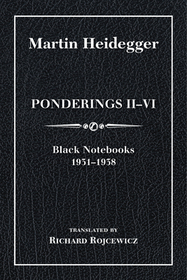
Ponderings II–VI begins the much-anticipated English translation of Martin Heidegger's ""Black Notebooks."" In a limited edition binding, this series of small notebooks with black covers, Heidegger confided sundry personal observations and ideas over the course of 40 years. The five notebooks in this volume were written between 1931–1938 and thus chronicle Heidegger's year as Rector of the University of Freiburg during the Nazi era. Published in German as volume 94 of the Complete Works, these challenging and fascinating journal entries shed light on Heidegger's philosophical development regarding his central question of what it means to be, but also on his relation to National Socialism and the revolutionary atmosphere of the 1930s in Germany. Readers previously familiar only with excerpts taken out of context may now determine for themselves whether the controversy and censure the ""Black Notebooks"" have received are deserved or not. This faithful translation by Richard Rojcewicz opens the texts in a way that captures their philosophical and political content while disentangling Heidegger's notoriously difficult language.
" More
