

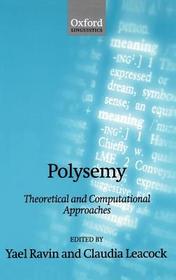
Polysemy
Theoretical and Computational Approaches
- Publisher's listprice GBP 205.00
-
92 557 Ft (88 150 Ft + 5% VAT)
The price is estimated because at the time of ordering we do not know what conversion rates will apply to HUF / product currency when the book arrives. In case HUF is weaker, the price increases slightly, in case HUF is stronger, the price goes lower slightly.
- Discount 10% (cc. 9 255 Ft off)
- Discounted price 83 302 Ft (79 335 Ft + 5% VAT)
Subcribe now and take benefit of a favourable price.
Subscribe
92 557 Ft

Availability
printed on demand
Why don't you give exact delivery time?
Delivery time is estimated on our previous experiences. We give estimations only, because we order from outside Hungary, and the delivery time mainly depends on how quickly the publisher supplies the book. Faster or slower deliveries both happen, but we do our best to supply as quickly as possible.
Product details:
- Publisher OUP Oxford
- Date of Publication 15 June 2000
- ISBN 9780198238423
- Binding Hardback
- No. of pages242 pages
- Size 241x162x17 mm
- Weight 496 g
- Language English
- Illustrations 11 black and white figures 0
Categories
Short description:
Polysemy is a term used in semantic and lexical analysis to describe a word with multiple meanings. The problem is to establish whether its the same word with related meanings or different words that happen to look or sound the same. In 'Plainly planes plane plains plainly' how many distinct lexical items are there? Such words present few difficulties in everyday language, but pose near-intractable problems for linguists and lexicographers. The contributors, including Anna Wierzbicka, Charles Fillmore, and James Pustejovsky, consider the implications of these problems for grammatical theory and how they may be addressed in computational linguistics.
MoreLong description:
This volume of newly commissioned essays examines current theoretical and computational work on polysemy, the term used in semantic analysis to describe words with more than one meaning or function, sometimes perhaps related (as in plain) and sometimes perhaps not (as in bank). Such words present few difficulties in everyday language, but pose central problems for linguists and lexicographers, especially for those involved in lexical semantics and in computational modelling. The contributors to this book–leading researchers in theoretical and computational linguistics–consider the implications of these problems for grammatical theory and how they may be addressed by computational means.
The theoretical essays in the book examine polysemy as an aspect of a broader theory of word meaning. Three theoretical approaches are presented: the Classical (or Aristotelian), the Prototypical, and the Relational. Their authors describe the nature of polysemy, the criteria for detecting it, and its manifestations across languages. They examine the issues arising from the regularity of polysemy and the theoretical principles proposed to account for the interaction of lexical meaning with the semantics and syntax of the context in which it occurs. Finally they consider the formal representations of meaning in the lexicon, and their implications for dictionary construction.
The computational essays are concerned with the challenge of polysemy to automatic sense
disambiguation–how intended meaning for a word occurrence can be identified. The approaches presented include the exploitation of lexical information in machine-readable dictionaries, machine learning based on patterns of word co-occurrence, and hybrid approaches that combine the two.
As a whole, the volume shows how on the one hand theoretical work provides the motivation and may suggest the basis for computational algorithms, while on the other computational results may validate, or reveal problems in, the principles set forth by theories.
This volume distinguishes itself by its very catholic table of contents ... the chapters themselves stand as valuable contributions to the debate about what polysemy is and how it is to be represented in (psycho)linguistic and computational models.
Table of Contents:
Polysemy: An overview
Aspects of the Micro-Structure of Word Meanings
Autotroponomy
Lexical Shadowing and Argument Closure
Describing Polysemy: The case of Crawl
The Garden Swarms with Bees and the Fallacy of 'Argument Alternation'
Polysemy: A problem of definition
Lexical Representations for Sentence Processing
Large Vocabulary Word Sense Disambiguation
Polysemy in a Broad-Coverage Natural Language Processing System
Disambiguation and Connectionism

