

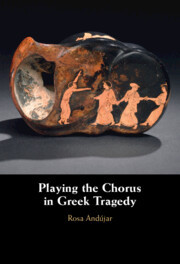
Playing the Chorus in Greek Tragedy
- Publisher's listprice GBP 95.00
-
42 892 Ft (40 850 Ft + 5% VAT)
The price is estimated because at the time of ordering we do not know what conversion rates will apply to HUF / product currency when the book arrives. In case HUF is weaker, the price increases slightly, in case HUF is stronger, the price goes lower slightly.
- Discount 10% (cc. 4 289 Ft off)
- Discounted price 38 603 Ft (36 765 Ft + 5% VAT)
Subcribe now and take benefit of a favourable price.
Subscribe
42 892 Ft

Availability
Estimated delivery time: In stock at the publisher, but not at Prospero's office. Delivery time approx. 3-5 weeks.
Not in stock at Prospero.
Why don't you give exact delivery time?
Delivery time is estimated on our previous experiences. We give estimations only, because we order from outside Hungary, and the delivery time mainly depends on how quickly the publisher supplies the book. Faster or slower deliveries both happen, but we do our best to supply as quickly as possible.
Product details:
- Publisher Cambridge University Press
- Date of Publication 6 November 2025
- ISBN 9781009653602
- Binding Hardback
- No. of pages350 pages
- Size 229x152x21 mm
- Weight 677 g
- Language English 735
Categories
Short description:
A comprehensive rethinking of the chorus, emphasising its dynamism in performance, which ranges across Greek tragedy, satyr play, and comedy.
MoreLong description:
Modern audiences see the chorus as an emblematic yet static element of ancient Greek drama, whose reflective songs puncture the action. This is the first book to look beyond these odes to the group's complex and varied roles as actors and physical performers. It argues that the chorus' flexibility and interactive nature has been occluded by the desire from Aristotle onwards to assign the group a single formal role. It presents four choreographies that ancient playwrights employed across tragedy, satyr play, and comedy: fragmentation, augmentation, interruption, and interactivity. By illustrating how the chorus was split, augmented, interrupted, and placed in dialogue, this book shows how dramatists experimented with the chorus' configuration and continual presence. The multiple self-reflexive ways in which ancient dramatists staged the group confirms that the chorus was not only a nimble dramatic instrument, but also a laboratory for experimenting with a range of dramatic possibilities.
MoreTable of Contents:
Introduction; 1. Fragmenting the chorus; 2. Augmenting the chorus; 3. Interrupting the chorus; 4. Interacting with the chorus; Coda: choral politics.
More
