

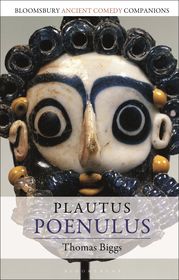
Plautus: Poenulus
Series: Bloomsbury Ancient Comedy Companions;
-
GET 18% OFF
- Publisher's listprice GBP 75.00
-
33 862 Ft (32 250 Ft + 5% VAT)
The price is estimated because at the time of ordering we do not know what conversion rates will apply to HUF / product currency when the book arrives. In case HUF is weaker, the price increases slightly, in case HUF is stronger, the price goes lower slightly.
- Discount 18% (cc. 6 095 Ft off)
- Discounted price 27 767 Ft (26 445 Ft + 5% VAT)
- Discount is valid until: 31 August 2026
27 767 Ft

Availability
printed on demand
Why don't you give exact delivery time?
Delivery time is estimated on our previous experiences. We give estimations only, because we order from outside Hungary, and the delivery time mainly depends on how quickly the publisher supplies the book. Faster or slower deliveries both happen, but we do our best to supply as quickly as possible.
Product details:
- Publisher Bloomsbury Publishing (UK)
- Date of Publication 9 July 2026
- Number of Volumes Hardback
- ISBN 9781350379060
- Binding Hardback
- No. of pages208 pages
- Size 218x138x18 mm
- Weight 360 g
- Language English
- Illustrations 11 bw illus 0
Categories
Long description:
Plautus' Poenulus (The Little Carthaginian) is a work of staggering literary and
historical significance. Performed in the long shadow of Rome's struggle with
Hannibal's Carthage, this play stages the restoration of a Carthaginian family
divided through enslavement. Set against the backdrop of a Greece marked by
comedic expectations and the geography of contemporary imperial conquest,
Poenulus presents a tale of Carthaginian heartbreak and heartache to a postwar
Roman audience. The comedy's remarkable diversity prompts audience
interaction with a wide range of socio-cultural topics relevant to Plautus' time.
Engaging weighty matters through song, slapstick, puns, and spectacle, Poenulus
may appear to defang, but its bite is deep.
This book offers an innovative understanding of Poenulus' place in Roman history
and literary culture, helping readers to appreciate the play itself, the complex
nature of Plautine authorship, and the cultures of performance in Republican
Rome. Most of the book explores the play as a performance, from its unique and
strikingly self-aware prologue to the actors' call for applause in the final line.
The longest chapter examines the play's afterlives in the Renaissance and early
modern period, including little-known revivals and adaptations in Ferrara, Rome,
and Cambridge. Over the centuries, people have found in Poenulus a script well
suited to active learning in the Latin classroom, a text capable of supporting
new political ideologies, and a dramatized vision of the world that accorded
with processes of racialization in Europe as reengagement with the classical past
coincided with the expansion of the slave trade and the objectification of Black
Africans. That one play has been seen to support and subvert the same outlooks
and practices is a testament to its complexity and to the enduring power of all Plautine verse from the third century BCE to the present.
Table of Contents:
Acknowledgements
Preface
Illustrations
1. Introduction
2. Prologue
3. Plots, Plots, and Characters
4. Hanno(s)
5. Reception: Ferrara, Rome, Cambridge
Epilogue
Bibliography
Notes
Index

