

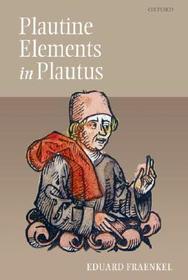
Plautine Elements in Plautus
- Publisher's listprice GBP 222.50
-
106 299 Ft (101 237 Ft + 5% VAT)
The price is estimated because at the time of ordering we do not know what conversion rates will apply to HUF / product currency when the book arrives. In case HUF is weaker, the price increases slightly, in case HUF is stronger, the price goes lower slightly.
- Discount 10% (cc. 10 630 Ft off)
- Discounted price 95 669 Ft (91 113 Ft + 5% VAT)
Subcribe now and take benefit of a favourable price.
Subscribe
106 299 Ft

Availability
printed on demand
Why don't you give exact delivery time?
Delivery time is estimated on our previous experiences. We give estimations only, because we order from outside Hungary, and the delivery time mainly depends on how quickly the publisher supplies the book. Faster or slower deliveries both happen, but we do our best to supply as quickly as possible.
Product details:
- Publisher OUP Oxford
- Date of Publication 30 November 2006
- ISBN 9780199249107
- Binding Hardback
- No. of pages496 pages
- Size 240x160x35 mm
- Weight 883 g
- Language English 0
Categories
Short description:
Eduard Fraenkel was one of the most influential classicists of the twentieth century. His Plautine Elements in Plautus (originally published in German in 1922) revolutionized the study of Roman comedy. This translation makes this seminal work accessible to an English-speaking readership for the first time.
MoreLong description:
Eduard Fraenkel was one of the most influential classicists of the twentieth century. His Plautine Elements in Plautus (originally published in German in 1922) revolutionized the study of Roman comedy. It is still essential reading for students and scholars of Plautus. This translation makes it accessible to an English-speaking readership for the first time. All Latin and Greek is translated, thus making the work available to a wider audience consisting of all those interested in Roman drama. The book includes a translation of the Addenda to the Italian translation published in 1960. The English translation is prefaced by an essay which gives an introduction to developments in Plautine scholarship since 1960.
Deeply satisfactory
Table of Contents:
Introduction
Comparative openings of speeches
Transformation and identification motifs
Mythological material
Animating the inanimate
Expansion of the dialogue
Expansion of monologues
Implausibility in conversations
The predominance of the slave's role
`Contaminated' plays
The nature and origins of the cantica
Plautus as a poet

