

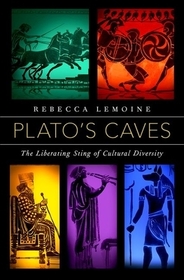
Plato's Caves
The Liberating Sting of Cultural Diversity
- Publisher's listprice GBP 90.00
-
42 997 Ft (40 950 Ft + 5% VAT)
The price is estimated because at the time of ordering we do not know what conversion rates will apply to HUF / product currency when the book arrives. In case HUF is weaker, the price increases slightly, in case HUF is stronger, the price goes lower slightly.
- Discount 10% (cc. 4 300 Ft off)
- Discounted price 38 698 Ft (36 855 Ft + 5% VAT)
Subcribe now and take benefit of a favourable price.
Subscribe
42 997 Ft

Availability
Estimated delivery time: In stock at the publisher, but not at Prospero's office. Delivery time approx. 3-5 weeks.
Not in stock at Prospero.
Why don't you give exact delivery time?
Delivery time is estimated on our previous experiences. We give estimations only, because we order from outside Hungary, and the delivery time mainly depends on how quickly the publisher supplies the book. Faster or slower deliveries both happen, but we do our best to supply as quickly as possible.
Product details:
- Publisher OUP USA
- Date of Publication 20 February 2020
- ISBN 9780190936983
- Binding Hardback
- No. of pages288 pages
- Size 163x236x25 mm
- Weight 567 g
- Language English 0
Categories
Short description:
From student protests over the teaching of canonical texts such as Plato's Republic to the use of images of classical Greek statues in white supremacist propaganda, the world of the ancient Greeks is deeply implicated in a heated contemporary debate about identity and diversity. In Plato's Caves, Rebecca LeMoine defends the bold thesis that Plato was a friend of cultural diversity, contrary to many contemporary perceptions. Through close readings of four Platonic dialogues--Republic, Menexenus, Laws, and Phaedrus--LeMoine shows that, across Plato's dialogues, foreigners play a role similar to that of Socrates: liberating citizens from intellectual bondage.
MoreLong description:
Months before the 2016 United States presidential election, universities across the country began reporting the appearance of white nationalist flyers featuring slogans like "Let's Become Great Again" and "Protect Your Heritage" against the backdrop of white marble statues depicting figures such as Apollo and Hercules. Groups like Identity Evropa (which sponsored the flyers) oppose cultural diversity and quote classical thinkers such as Plato in support of their anti-immigration views. The traditional scholarly narrative of cultural diversity in classical Greek political thought often reinforces the perception of ancient thinkers as xenophobic, and this is particularly the case with interpretations of Plato. While scholars who study Plato reject the wholesale dismissal of his work, the vast majority tend to admit that his portrayal of foreigners is unsettling. From student protests over the teaching of canonical texts such as Plato's Republic to the use of images of classical Greek statues in white supremacist propaganda, the world of the ancient Greeks is deeply implicated in a heated contemporary debate about identity and diversity.
In Plato's Caves, Rebecca LeMoine defends the bold thesis that Plato was a friend of cultural diversity, contrary to many contemporary perceptions. LeMoine shows that, across Plato's dialogues, foreigners play a role similar to that of Socrates: liberating citizens from intellectual bondage. Through close readings of four Platonic dialogues--Republic, Menexenus, Laws, and Phaedrus--LeMoine recovers Plato's unique insight into the promise, and risk, of cross-cultural engagement. Like the Socratic "gadfly" who stings the "horse" of Athens into wakefulness, foreigners can provoke citizens to self-reflection by exposing contradictions and confronting them with alternative ways of life. The painfulness of this experience explains why encounters with foreigners often give rise to tension and conflict. Yet, it also reveals why cultural diversity is an essential good. Simply put, exposure to cultural diversity helps us develop the intellectual humility we need to be good citizens and global neighbors. By illuminating Plato's epistemological argument for cultural diversity, Plato's Caves challenges readers to examine themselves and to reinvigorate their love of learning.
Plato's Caves offers us a remarkably coherent and compelling vision of what a Platonic theory of cultural diversity would entail. We might think of LeMoine's book as doing the provocative work of the gadfly celebrated in its pages, prompting us to remember that there is still much in the thought of this seemingly familiar philosopher that remains to be better understood.
Table of Contents:
Acknowledgments
1. Introduction
2. Setting the Stage: A World of Caves
Part I: Athenians and foreigners
3. The Panharmonic Music of the Piraeus: Diversity, Democracy, and Philosophy in the Republic
4. Civic Myths through Immigrant Voices: Aspasia as Gadfly in the Menexenus
Part II: Athenians as foreigners
5. An Athenian in Crete: Moderating the Song of the Armed Camp in the Laws
6. Socrates the Foreigner? Self-Examination and Civic Identity in the Phaedrus
7. Conclusion
Notes
Bibliography
Index

